What Is the Lifespan of an Axial Fan? | Complete Guide
Learn how long axial fans last, what L10 life means, which conditions shorten service life, and how inspection and maintenance reduce failures.
Read More
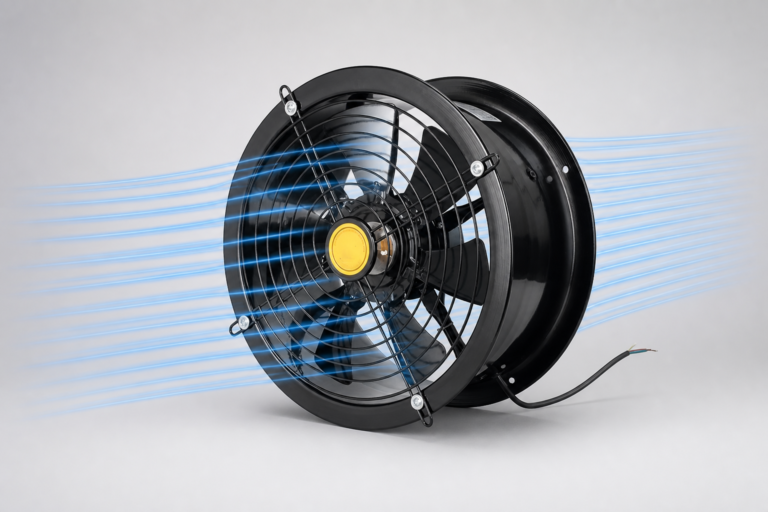
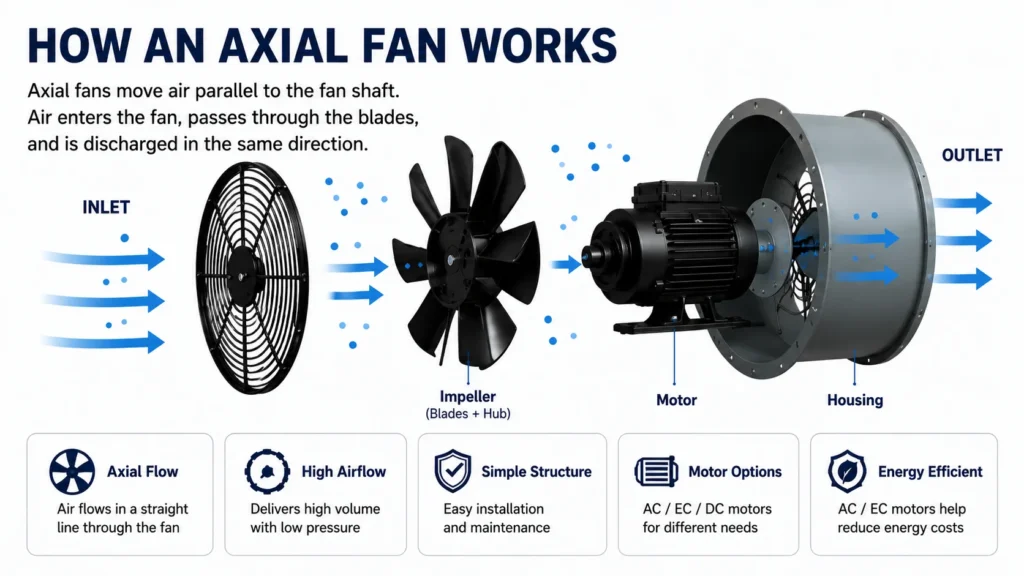
An axial fan moves air or gas along the axis of its rotating blades. Air enters and exits in the same direction — straight through the fan — producing high airflow rates at relatively low pressure. This linear path distinguishes axial fans from centrifugal fans, which redirect air at a 90-degree angle.
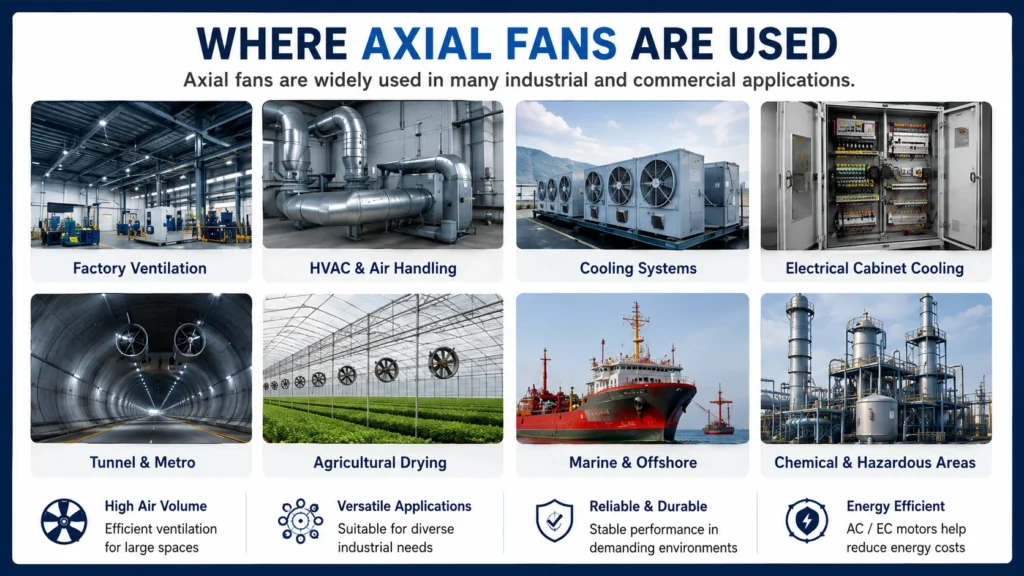
Axial fans are the backbone of industrial ventilation. You find them in factory exhaust systems, HVAC ductwork, cooling towers, electrical enclosure cooling, and agricultural drying operations. The straightforward design — a motor, blade assembly, and housing — keeps them cost-effective to manufacture, simple to install, and easy to maintain.
The core trade-off is volume versus pressure. Axial fans excel at moving large volumes when resistance is low. If your system involves long duct runs, dense filters, or high back pressure, a centrifugal fan may be the better fit — we cover that comparison below.
The operating principle is straightforward. The motor spins angled blades attached to a central hub. Blade rotation creates a pressure differential: low pressure on the intake side draws air in; higher pressure on the discharge side pushes it out. The airflow stays parallel to the shaft, minimizing energy loss.
Four components work together:
Performance is defined by the fan curve — the relationship between airflow (CFM or m³/h) and static pressure (Pa). The real-world operating point is always where the fan curve intersects the system resistance curve.
Axial fans are classified by physical design and by motor technology. Both dimensions matter for selection.
| Type | Design Features | Typical Pressure Range | Best-Suited Applications |
|---|---|---|---|
| Propeller Fan | Simple blade-and-motor assembly; often open-mounted; 2–8 broad blades | Very low (0–50 Pa) | General ventilation, cooling towers, condenser cooling, warehouse air circulation |
| Tube-Axial Fan | Propeller inside a cylindrical duct; motor supported in airstream or externally | Low to medium (50–250 Pa) | Ducted exhaust, paint spray booths, fume extraction, factory ventilation |
| Vane-Axial Fan | Tube-axial design plus stationary guide vanes downstream to straighten airflow and recover pressure | Medium to high (250–1,500 Pa) | Long duct runs, HVAC air handling, tunnel ventilation, process air supply |
Propeller fans are simple and inexpensive but handle only minimal resistance. Vane-axial fans cost more upfront but deliver higher pressure and better efficiency in systems with substantial duct resistance.
Yian Electric manufactures axial fans across all three motor types, and the table below reflects real-world product specifications from the lineup:
| Motor Type | Voltage Options | Speed Control | Energy Efficiency | Verified Model Example |
|---|---|---|---|---|
| AC Axial Fan | 220V / 380V, 50/60 Hz | Fixed speed; variable with external VFD | Moderate | YWF4E-300: 220V, 90W, 1,370 RPM, 1,900 CFM, 55 dBA, IP54 |
| DC Axial Fan | 12V / 24V / 48V DC | Voltage or PWM control | High (up to 70% less power than AC) | DC Small Axial Fan: 12–48V, compact frame, 50,000-hr bearing life |
| EC Axial Fan | 1~230V / 3~400V, 50/60 Hz (universal input) | 0–10V DC / PWM; integrated PID controller; 4–20mA option | Very high (ErP-compliant) | EC-630 (PMDWF112L60-750H): 3~400V, 900W, 1,200 RPM, 13,464 m³/h, 74 dBA, IP54 |
EC fans represent the modern standard for variable-speed applications. The 0–10V DC/PWM control, integrated PID controller, and speed signal feedback built into Yian’s EC external rotor axial fans make them ideal for demand-controlled ventilation, refrigeration, and data center cooling.
The choice between axial and centrifugal is one of the most common decisions in ventilation system design:
| Criterion | Axial Fan | Centrifugal Fan |
|---|---|---|
| Airflow direction | Parallel to shaft (straight through) | 90° turn (radial discharge) |
| Flow / pressure profile | High volume, low pressure | Moderate volume, high static pressure |
| Space footprint | Compact, in-line installation | Larger — requires scroll housing |
| Noise level | Generally lower; primarily aerodynamic | Can be higher; both aerodynamic and mechanical |
| Dust tolerance | Better — open design resists clogging | Can accumulate debris in scroll |
| Efficiency at high resistance | Drops off sharply | Efficient across a wide pressure range |
Rule of thumb: If air moves freely through a short duct, open panel, or large space with minimal obstruction, use an axial fan. If air must be pushed through long ducts, dense filters, or multiple bends, a centrifugal fan is the right call.
The table below maps each selection factor to the information a buyer should prepare before requesting a quotation or model recommendation. Providing these details helps an application engineer match the right fan to your operating conditions on the first attempt.
| Selection Factor | What the Buyer Should Provide |
|---|---|
| Airflow | Required m³/h or CFM at the operating point |
| Static Pressure | Total system resistance in Pa (include ducts, filters, dampers, louvers) |
| Power Supply | Voltage, frequency, and phase (e.g., 1~230V / 50Hz or 3~400V / 60Hz) |
| Installation | Wall, panel, duct, condenser, enclosure, or free-standing |
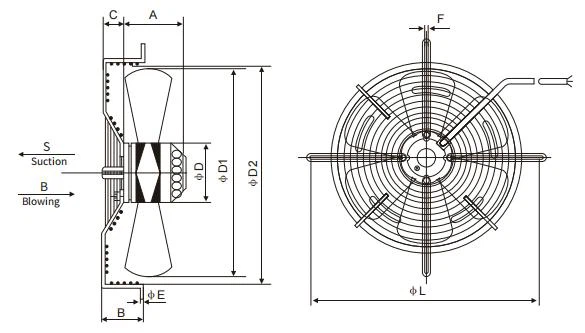
| Size | Fan diameter and mounting-hole pattern (e.g., YWF-400 ∅L=470mm, 4-∅9 mounting holes) |
| Environment | Ambient temperature range, humidity, corrosive or dusty conditions |
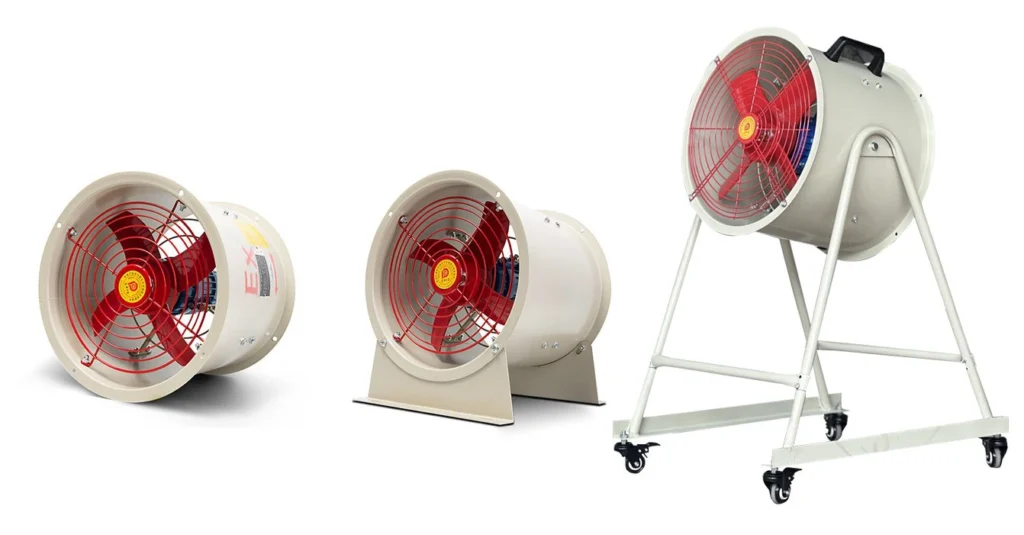
| Protection | Required IP rating (IP54, IP55) and any ATEX / Ex hazard-area classification |
| Control | Fixed speed, 0–10V DC, PWM, 4–20mA, or VFD compatibility |
To ground these selection factors in actual product data, here are three verified examples from the Yian axial fan range:
A propeller fan is the simplest subtype of axial fan. All propeller fans are axial, but not all axial fans are propeller fans. Propeller fans lack an enclosed housing beyond a mounting ring and are designed for low-resistance, open-air applications. Tube-axial and vane-axial fans add housings and guide vanes for higher-pressure industrial use.
It depends on the design. Standard propeller fans cannot handle significant duct resistance. Tube-axial fans manage short to moderate duct runs. For long ductwork with multiple bends, a vane-axial fan or a centrifugal fan is the better choice. Always calculate total system static pressure and check the fan curve before committing.
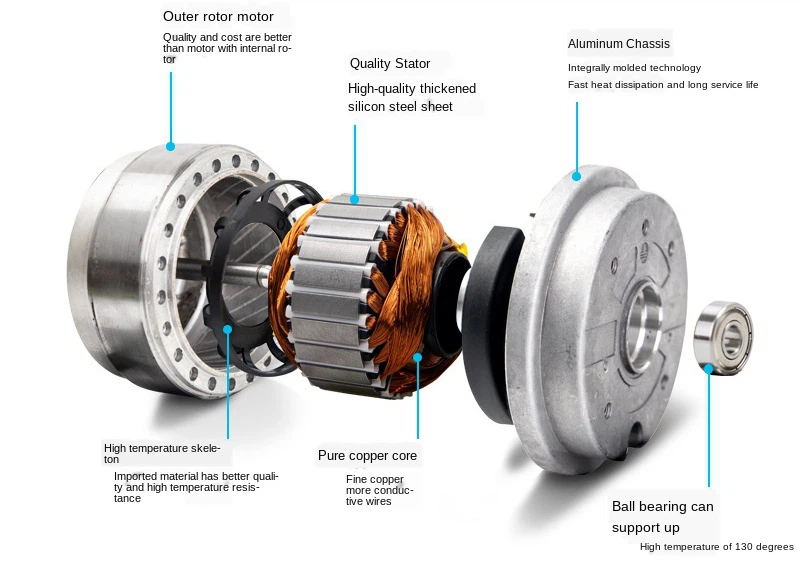
With proper maintenance, a well-built industrial axial fan operates reliably for 10–15 years or more. Key factors: operating hours per day, ambient temperature, contaminant exposure, and bearing quality. Yian external rotor axial fans use maintenance-free ball bearings rated for continuous S1 duty.
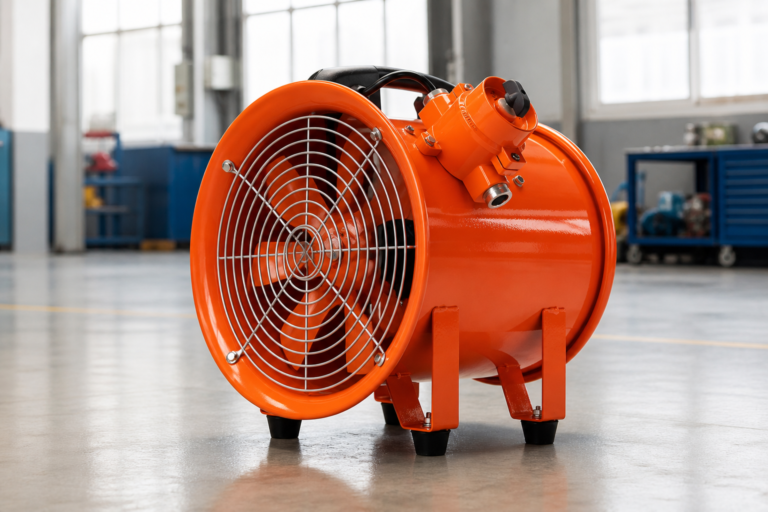
Yes — and the requirement is regulation-driven as well as safety-driven. Standard fans can generate sparks from motor brushes, static, or friction. In environments with flammable gases or combustible dust, a single spark can cause an explosion. Explosion-proof fans with flameproof enclosures and certified motor designs are mandatory under ATEX, IECEx, and GB3836 codes. The CBF series carries Exd II BT4 certification for Zone 1 and Zone 2 hazardous areas.
Several strategies work: install a larger-diameter fan running at lower RPM (moves the same airflow with less noise); choose a vane-axial design with optimized blade profiles; add inlet or outlet silencers; mount on vibration isolators; and use EC motors with speed control to reduce RPM during low-demand periods.
The certifications that matter depend on your region. CE marking for the European Economic Area. Exd II BT4 / ATEX / IECEx for hazardous locations. For quality management, ISO 9001 certification provides confidence in production standards. Energy-efficiency certifications such as ErP (EU) are increasingly required by regulation.
Selecting the right fan means matching airflow, pressure, environment, and control requirements to a specific model’s performance curve. The best choice is not the most expensive one — it is the one whose design parameters fit your actual operating conditions.
Send us your application details through our contact page and include the following:
Our application engineering team will recommend a suitable model from the AC, EC, or explosion-proof ranges with the performance data to match your project.