AC Fan vs EC Fan: Differences, Costs, and Best Uses
Compare AC and EC fans by motor design, efficiency, speed control, noise, cost, and application to choose the right solution.
Read More
A small AC centrifugal blower moves air through compact equipment where ducts, filters or narrow passages create resistance. Unlike choosing a fan by its largest airflow number, selecting a blower means checking how much air it delivers at the pressure your equipment actually requires.
This guide explains what to specify, when a centrifugal design makes sense, and how to compare a product listing with your installation needs. The starting point is simple: define the airflow and pressure together, then check the electrical supply and physical fit.
A small AC centrifugal blower is a compact air-moving assembly powered from an alternating-current supply. Air enters near the impeller center and is accelerated outward by the rotating blades. In a housed blower, the scroll collects the airflow and directs it toward the outlet.
Here, AC means alternating current, not air conditioning. “Small” describes the installation scale rather than a universal size standard. Check the full assembly dimensions, including the motor, outlet and mounting brackets, instead of assuming the impeller diameter defines the space required.
The small centrifugal fan range is a useful starting point for comparing compact blower formats. A product family narrows the search; its individual performance data determines suitability.
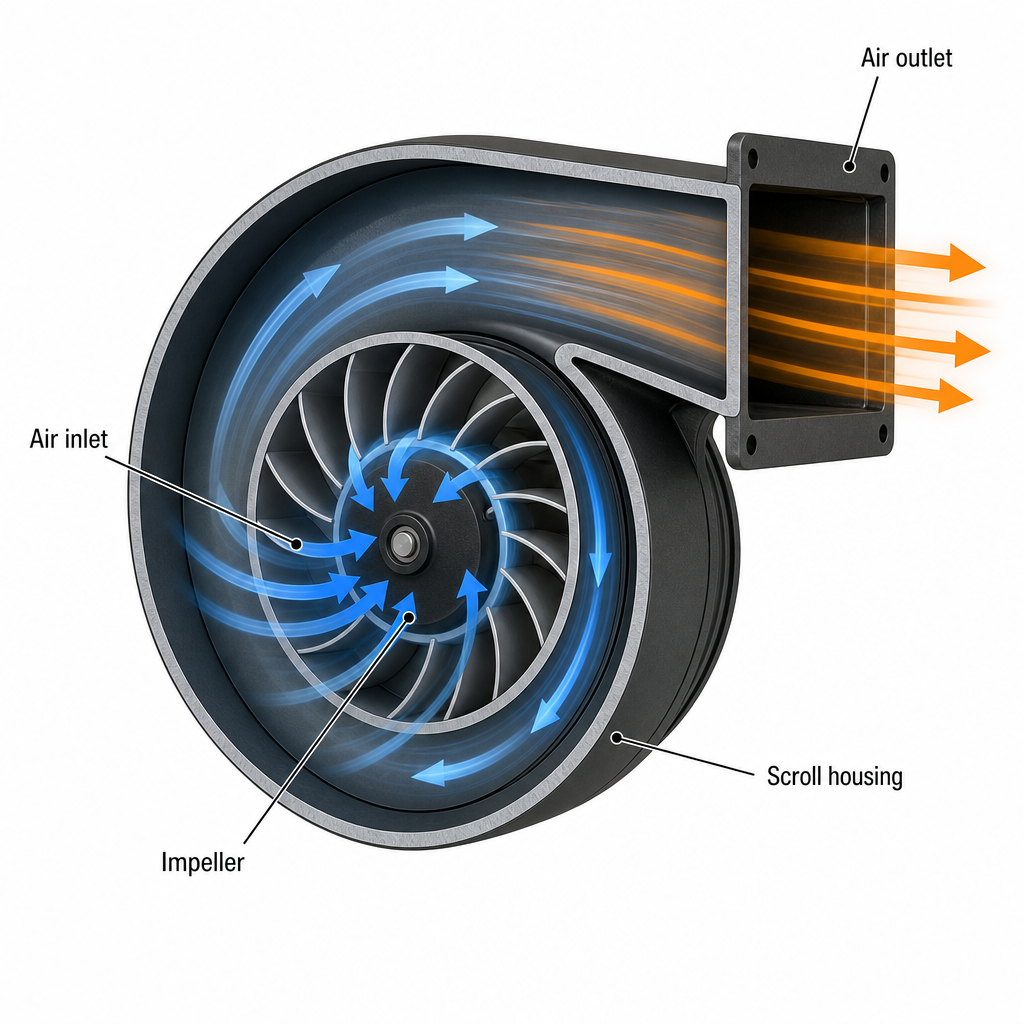
Conceptual illustration of blower components; not a model-specific engineering drawing.
Consider a centrifugal blower when you need directed airflow through a restricted path. An axial fan is often worth evaluating first for a short, open ventilation path. Neither design is automatically better: compare actual curves at your required airflow.
| Equipment condition | Starting point | What to verify |
|---|---|---|
| Short, relatively open intake and exhaust | Axial fan | Airflow after guards and vents are installed |
| Filter and narrow internal channel | Centrifugal blower comparison | Pressure capability with the filter in service |
| Air directed into a duct or local cooling outlet | Housed centrifugal blower | Outlet connection and delivered airflow |
| Very limited installation depth | Compare complete assemblies | Motor clearance, inlet access and duct routing |
Oriental Motor’s centrifugal blower overview identifies cooling, drying and ducted airflow as typical applications. These uses still require model-specific selection, particularly when heat or contamination is involved.
If your equipment has a relatively open airflow path, Yian Electric’s small axial fan selection guide covers the alternative in more detail.
Write the requirement as a pair: airflow in m³/h or CFM, and static pressure in Pa or inches of water. A request for “a powerful small blower” leaves suppliers without a measurable selection target.
Maximum airflow and maximum static pressure are separate endpoints, not a combined rating. The installed operating point is where the fan curve intersects the system-resistance curve, as explained in ebm-papst’s fan-performance FAQ.
For example, suppose your equipment requires 80 m³/h at 120 Pa. These are hypothetical design values, not a Yian product specification. A listing showing 150 m³/h maximum airflow does not establish whether the blower meets that requirement. Request the curve and ask the supplier to identify the proposed duty point.
For filtered equipment, include both a clean-filter condition and the intended filter replacement condition in your specification. That gives the supplier two conditions to evaluate instead of an unexplained percentage margin.
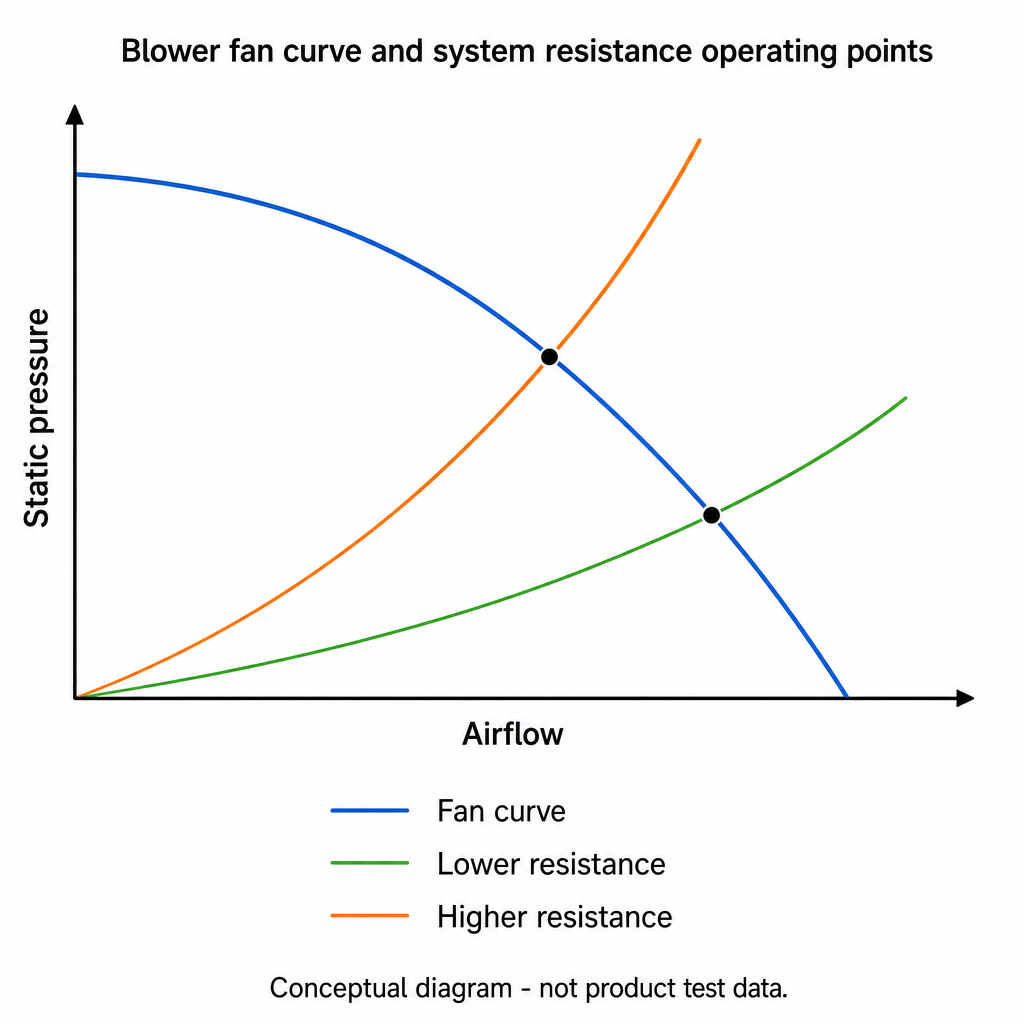
Conceptual curves showing the effect of system resistance; not product test data.
Record the supply voltage, frequency and phase. A blower marked for 220 V, 50 Hz should not be assumed suitable for 110 V or 60 Hz. Use the exact model label and approved documentation, including any separate performance data for different supplies.
Ask whether a capacitor or controller is required and whether it is included. Keep these as purchase-order line items where applicable. A mechanically correct replacement can still be unsuitable if its electrical connections or required accessories differ.
Measure the available envelope before choosing a model. Include inlet clearance, outlet orientation, flange dimensions, mounting-hole spacing and access for wiring. For replacements, attach photographs and the old unit’s nameplate, but use dimensions and specifications to establish equivalence.
Consider how technicians will remove the blower and service nearby filters. A unit that fits only before surrounding components are installed can create avoidable maintenance work. Confirm the allowed mounting orientation with the supplier.
Do not compare noise figures without their test conditions. Ask for the measurement distance and whether the figure is sound pressure or sound power. For equipment used near operators, specify an installed-system noise target and verify it during sample testing.
Record operating hours, ambient temperature, inlet-air temperature and exposure to moisture or contamination. Ask the supplier to confirm suitability in writing. General-purpose cooling equipment should not be treated as approved for hazardous gases, combustible dust or hot exhaust simply because it can move air.
Start with the available power and required controls. A conventional AC blower may fit line-powered equipment with a steady operating requirement. A DC blower may be convenient where the equipment already provides a compatible DC supply.
EC means electronically commutated. Some EC blowers accept AC mains input while using integrated electronic motor control. Therefore, “AC input” alone does not identify the motor technology. ebm-papst’s centrifugal fan range illustrates AC and EC options within centrifugal products.
When adjustable airflow matters, ask which control interface the exact model supports. Do not assume every blower accepts the same controller. Compare purchase price, measured input power at the required duty and expected operating hours rather than assuming one motor label guarantees the lowest overall cost.
Yian Electric’s AC Power Frequency Centrifugal Fan page lists the following values for the 220 V version of model 130FLJ0:
| Published parameter | Listed value |
|---|---|
| Voltage and frequency | 220 VAC, 50 Hz |
| Power | 60 W |
| Rotational speed | 2,600 RPM |
| Air volume | 168 m³/h |
| Pressure | 200 Pa |
These figures support an initial comparison, not a final design decision. The listing does not establish that 168 m³/h is delivered at 200 Pa simultaneously. Request the current performance curve, drawing and electrical documentation for the exact version before specifying it.
Use the same approach when comparing suppliers: align supply conditions, test setup and model variants before judging which unit meets the requirement.
A concise technical request makes recommendations easier to evaluate. Include:
Use the small AC centrifugal blower category to organize an initial shortlist. Then ask for a documented recommendation and test a sample in the finished airflow path before committing to a production order.
Do not assume compatibility. Select a version explicitly rated for your supply. If a conversion arrangement is proposed, have the blower supplier confirm the complete setup rather than relying on voltage alone.
Only when approved for that frequency and voltage combination. Check the label and documentation; performance and electrical loading may differ between supplies. A dual-frequency rating should be explicit.
Possibly, but the method is motor-specific. Obtain the approved controller specification and operating range. Do not connect a generic dimmer or drive without confirmation of compatibility.
The installed air path introduces resistance that is absent from a free-air rating. Check filters, outlet restrictions and the full system layout, then compare the resulting duty point with the supplier’s curve.
No. A centrifugal blower’s airflow path depends on its impeller and housing geometry. Oriental Motor’s reversal guidance explains that changing rotation does not exchange the suction and discharge ports and reduces performance.
The right small AC centrifugal blower meets your airflow requirement against the installed resistance, fits the equipment and matches its electrical supply. Treat headline ratings as screening information, then confirm the choice with current documentation and an installed test.
Send Yian Electric your airflow and pressure target, supply details and installation drawing to discuss a suitable blower for your equipment.