AC Fan vs EC Fan: Differences, Costs, and Best Uses
Published: Author: Rachel
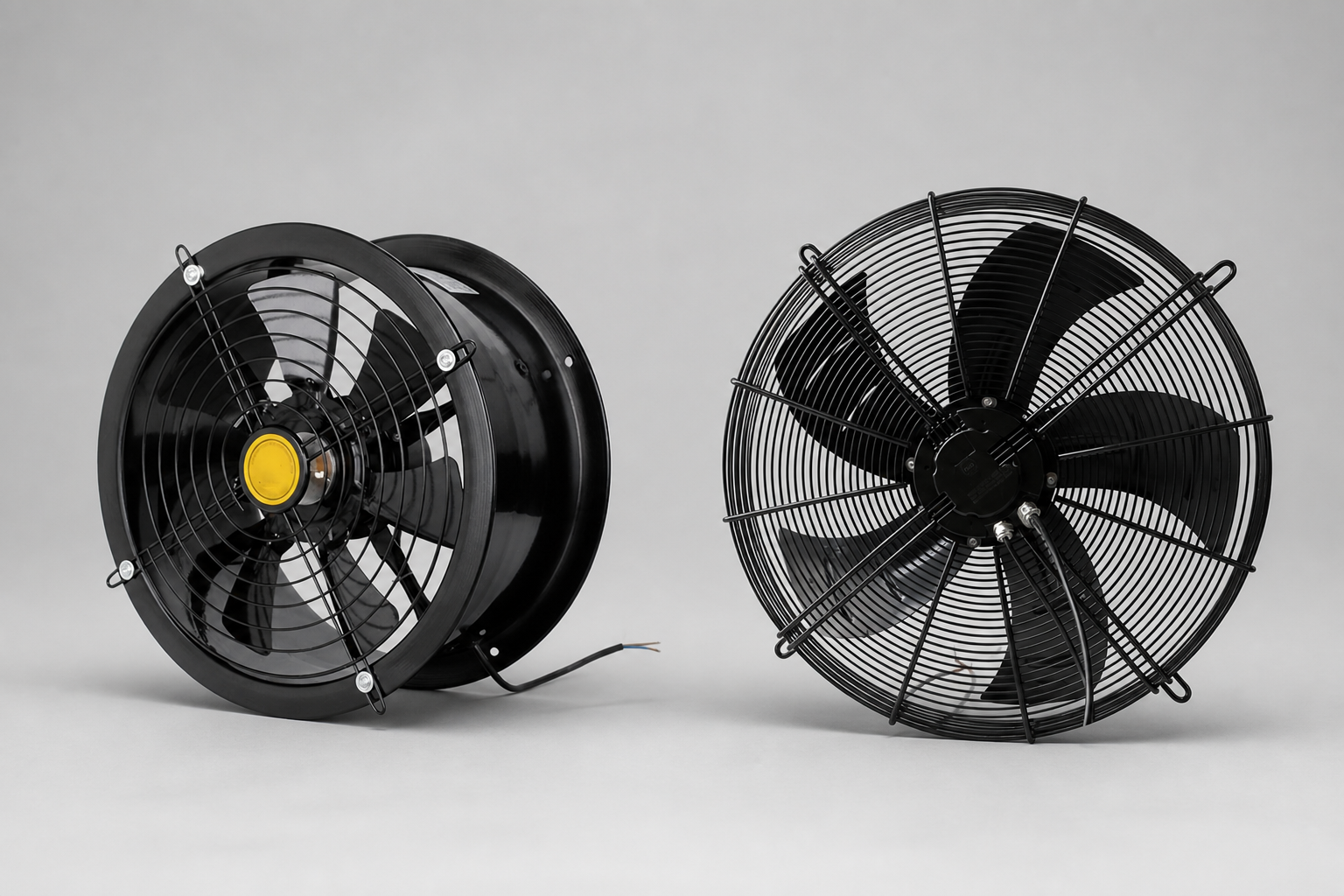
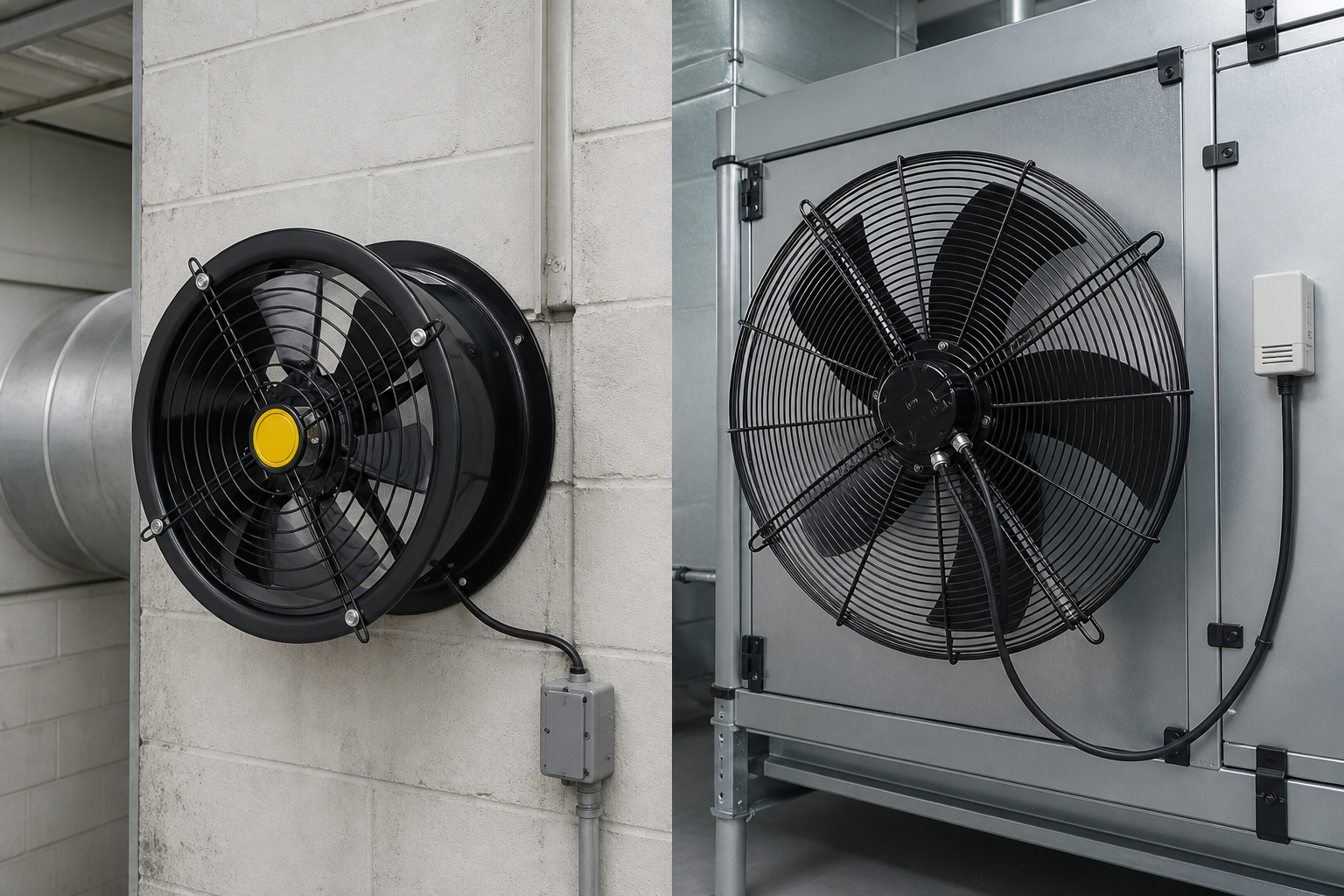
In an AC fan vs EC fan comparison, the main difference is the motor and control system. A conventional AC fan uses an alternating-current motor connected directly to the power supply or controlled by separate equipment. An EC fan uses a permanent-magnet, electronically commutated motor with integrated electronics that convert and control the incoming power.
The practical result is straightforward: AC fans are usually simpler and less expensive to purchase, while EC fans generally provide easier variable-speed control and better efficiency at part load. The right choice depends on operating hours, airflow demand, controls, installation environment, maintenance strategy, and total cost—not on the motor label alone.
What Is the Difference Between an AC Fan and an EC Fan?
An AC fan is powered by an AC motor, commonly an induction, permanent-split-capacitor, or shaded-pole design depending on its size and application. Motor speed is related to supply frequency and motor construction. Some AC fans run at one fixed speed, while others offer tapped speeds, voltage regulation, or variable-frequency-drive control when the motor is designed for it.
EC stands for electronically commutated. An EC fan normally accepts AC mains power, rectifies it internally, and uses electronic switching to operate a brushless permanent-magnet motor. The motor and controller are engineered as an integrated package. Many models accept a 0–10 V, PWM, or digital control signal, although the available interface must always be checked on the specific model.
Factor
AC fan
EC fan
Motor principle
Typically induction, PSC, or shaded-pole
Brushless permanent-magnet motor with electronic commutation
Power input
AC supply directly to the motor
AC supply converted and controlled by integrated electronics
Speed control
Fixed speed or separate compatible controller/VFD
Usually integrated; model-dependent control input
Part-load operation
Depends strongly on motor and control method
Generally efficient and easy to modulate
Initial cost
Usually lower
Usually higher
System integration
Simple for fixed-speed duty; extra components may be needed for control
Well suited to sensors, controllers, and building-management systems
How AC and EC Fan Motors Work
AC Fan Operation
An AC motor produces a rotating magnetic field from the alternating supply. In an induction motor, that field induces current in the rotor and creates torque. Rotor speed remains below the field’s synchronous speed; the difference is called slip. This mature architecture can be robust, economical, and appropriate for continuous fixed-duty service.
Variable speed is possible, but the method matters. A compatible AC motor can be paired with a VFD, while some smaller fans use voltage or phase-angle control. Incorrect control can cause noise, heat, poor torque, or motor damage, so the fan manufacturer’s approved method and minimum speed must be followed.
EC Fan Operation
An EC motor uses permanent magnets in the rotor and electronically switches current through the stator windings. Sensors or control algorithms determine rotor position so the electronics can apply current at the correct time. Because commutation is electronic, there are no brushes to wear.
The electronics, motor, and fan wheel are usually matched as one assembly. This integration is why EC products can offer smooth speed commands, soft starting, motor protection, status feedback, or constant-pressure and constant-airflow functions. These features vary by model and should never be assumed from the letters “EC” alone. A concise industry explanation is available in the HEVAC technical guide to EC motors.
Efficiency and Energy Use
EC fans often have the greatest advantage when airflow changes during the day. A demand-controlled system can reduce fan speed when full output is unnecessary, avoiding the energy waste of running at maximum speed and throttling airflow with a damper. For many fan systems, reducing speed can cut power substantially, but actual savings depend on the fan curve, system curve, controls, duty profile, and motor efficiency.
An efficient comparison must use the same required operating point. Do not compare two fans by input watts alone if their airflow or static pressure differs. Use tested fan data and compare complete assemblies—including an external drive or controller required by the AC option.
The strongest EC business case usually comes from long operating hours combined with substantial time at reduced airflow.
Speed Control and System Integration
For a simple full-speed exhaust application, an AC fan may need little more than appropriate protection and switching. When the system must respond continuously to temperature, pressure, carbon dioxide, occupancy, or equipment load, an EC fan can reduce component count because its motor controller is already built in.
Common EC commands include 0–10 V and PWM. Some products also support tachometer output, alarm contacts, Modbus, or other communications. Schneider Electric, for example, documents variable-speed EC motor use in fan-coil applications through its EC motor specification sheet. Interface voltage, signal isolation, wiring, fail-safe behavior, and electromagnetic-compatibility requirements still need to be verified.
AC systems can also deliver excellent variable-speed performance when a suitable motor and VFD are selected together. For larger fans, an AC motor plus drive may be serviceable, flexible, and competitive. The comparison should therefore be “complete EC package versus complete AC-plus-control package,” not EC electronics versus a bare AC motor.
Noise, Heat, and Maintenance
EC fans are often quieter at reduced demand because the controller can lower rotational speed smoothly. However, motor technology does not determine total sound by itself. Blade geometry, tip speed, operating point, inlet turbulence, guards, ducts, and structural vibration can dominate the result. Compare sound data at the same airflow and pressure.
Higher motor efficiency can also reduce waste heat, which may benefit electronics cooling and refrigerated equipment. Both AC and EC fans commonly use long-life ball bearings, so bearing condition, contamination, temperature, and balance remain important maintenance factors.
EC electronics add sensitivity that must be considered in hot, wet, electrically noisy, or surge-prone environments. Confirm ambient-temperature limits, IP protection, insulation, surge protection, and replacement strategy. A simple AC design may be preferable in a harsh location if advanced control offers little operating value.
Initial Cost vs Total Cost of Ownership
AC fans generally have a lower purchase price. EC fans add permanent-magnet materials and power electronics, so their upfront price is usually higher. Purchase price is only one part of the decision.
A useful total-cost comparison includes:
Fan, motor, external controller, sensors, and electrical-panel components
Installation, commissioning, cabling, and programming
Annual operating hours and the percentage of time at each airflow level
Electricity price and measured input power at relevant duty points
Maintenance labor, downtime, spares, and expected replacement life
Calculate annual energy with kWh = input kW × operating hours for each operating condition, then add the results. Avoid generic payback promises: two installations using the same fan can have very different economics if one runs continuously at variable load and the other operates occasionally at full speed.
When Should You Choose an AC Fan?
An AC fan is often the practical choice when:
The application runs at one speed and airflow demand is stable.
Operating hours are limited, reducing the value of efficiency savings.
Lowest initial cost is a primary constraint.
The existing system already uses a compatible AC motor controller or VFD.
Service teams prefer standardized motors and drives.
The environment requires a simple, appropriately certified solution.
Airflow must vary with temperature, pressure, occupancy, or process load.
The fan operates for long hours and spends meaningful time below full speed.
Compact integrated control simplifies the electrical design.
Low part-load energy use is a priority.
The application requires feedback, alarms, or building-management integration.
Reducing speed during low demand can improve acoustic performance.
The EC external rotor exhaust fan page shows the type of integrated, controllable fan package commonly used in modern ventilation equipment.
AC Fan vs EC Fan Selection Checklist
Define the duty point. Record airflow and static or total pressure rather than diameter alone.
Map the load profile. Estimate hours at full, medium, and low airflow.
Confirm the supply. Specify voltage, phase, frequency, and regional compliance needs.
List control functions. Identify required signals, feedback, alarms, and communications.
Check the environment. Include temperature, moisture, dust, corrosion, vibration, and surge exposure.
Compare complete systems. Include drives, filters, panels, sensors, and commissioning.
Review curves and sound data. Compare performance at the intended operating points.
Plan service. Confirm diagnostic access, spares, replacement lead time, and local expertise.
Motor technology is only one selection layer. Fan geometry and system resistance still determine whether the unit can deliver the required air. Read the axial fans guide for airflow and installation fundamentals, or the centrifugal fan guide when duct resistance and pressure are central to the application.
Frequently Asked Questions
Does an EC fan use AC or DC power?
Most EC fans connect to an AC supply, but their integrated electronics rectify and electronically control power to a brushless permanent-magnet motor. Always follow the voltage and wiring specification for the exact model.
Is an EC fan the same as a DC fan?
No. The motor principles may be related, but the power input, electronics, voltage range, packaging, and intended application can differ. The AC vs DC axial fan guide explains that separate comparison.
Can I replace an AC fan with an EC fan directly?
Not automatically. Check mounting dimensions, airflow and pressure curves, supply voltage, current protection, control wiring, communication signals, direction of rotation, and approvals. Retrofit work may require electrical and mechanical changes.
Do EC fans always save energy?
Not in every installation. Savings depend on comparable fan performance, operating hours, load profile, system resistance, and control strategy. The benefit is often greatest in variable-airflow applications with long run times.
Can an AC fan have variable speed?
Yes. Some AC motors support VFDs or other approved controllers. Compatibility, cooling at low speed, insulation, acoustic effects, and minimum operating speed must be checked with the manufacturer.
Which fan costs less over its lifetime?
It depends. AC often wins on initial price and simple fixed-duty service. EC may deliver a lower lifetime cost in long-hour, variable-demand systems. Use actual duty-point power and operating hours for the calculation.
Final Recommendation
Choose an AC fan for straightforward, fixed-speed duty when initial cost and service simplicity matter most. Choose an EC fan when integrated control, efficient part-load operation, and responsive airflow justify the higher purchase price. For either option, compare complete fan assemblies at the same airflow and pressure and verify the required electrical, environmental, and control specifications.
If you need a model-level comparison, send your airflow, pressure, supply, operating schedule, control signal, and installation conditions through the Yian Electric contact page.
Learn how to select a compact AC blower using its working airflow, pressure, electrical supply and installation needs, with a Yian Electric product example.
Learn how to select a compact AC or DC axial fan by checking heat load, airflow, static pressure, voltage, size, noise, bearing, environment, and supplier data.