AC vs DC Axial Fan: Which Is Right for Your Equipment?
Published: Author: Rachel
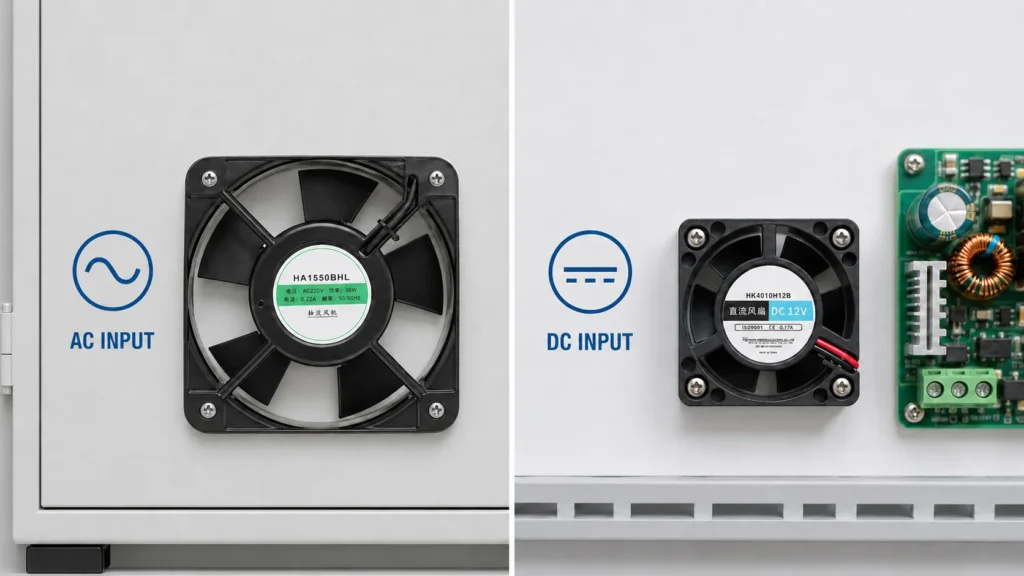
Choosing between an AC and DC axial fan is mainly a system-design decision. An AC axial fan is usually the practical choice when the equipment already has a compatible AC supply and needs straightforward, continuous cooling. A DC axial fan is usually more suitable when the equipment has a low-voltage DC rail or requires functions such as variable-speed control, tachometer feedback, or an alarm signal.
Neither type is automatically better in airflow, noise, efficiency, or service life. Those results depend on the exact fan design, frame size, speed, bearing, operating point, and installation. This guide compares AC vs DC axial fan options for equipment manufacturers, panel builders, distributors, and industrial buyers.
Start with the power source and control requirement:
Choose an AC axial fan when a suitable AC line supply is already available, fixed-speed operation is acceptable, and simple wiring is a priority.
Choose a DC axial fan when the equipment already uses low-voltage DC, airflow must change with temperature or load, or the controller needs speed or fault feedback.
Compare both types at the required airflow and static pressure. Maximum free-air CFM alone does not show how either fan will perform inside the equipment.
Selection factor
AC axial fan
DC axial fan
Input power
Specified AC line voltage and frequency
Specified low-voltage DC supply
Typical system fit
Control cabinets, industrial enclosures, line-powered equipment
Electronics, power supplies, automation modules, telecom equipment
Speed control
Depends on the motor and exact model
Voltage or PWM control may be available, depending on the model
Monitoring
Available on selected designs
Tachometer, alarm, or locked-rotor output is common on selected models
Regional electrical check
Voltage, frequency, phase, and grounding
Voltage tolerance, current, polarity, connector, and external power supply
Best reason to select
Direct fit with an available AC supply
Direct fit with a DC bus and greater control flexibility
What Is the Difference Between AC and DC Axial Fans?
Both products use an impeller to move air roughly parallel to the motor shaft. The main difference is how the motor receives and switches electrical power.
A conventional AC axial fan is designed for an alternating-current input at a specified voltage and frequency. In a line-powered cabinet, it can often be connected without adding a separate low-voltage fan supply. The wiring, protective earth, terminal arrangement, and acceptable frequency must still match the exact model.
Most modern compact DC axial fans use a brushless DC motor and an internal electronic commutation circuit. They require the correct DC input and polarity. Depending on the model, additional wires may carry a PWM command, tachometer pulse, running signal, or alarm output.
The words “AC” and “DC” describe the electrical input, not the complete performance of the fan. Two fans with the same voltage type can still differ significantly in airflow, pressure, noise, current, bearing design, environmental protection, and operating life.
Power Supply and Global Voltage Compatibility
For OEM projects, the best starting point is normally the power architecture already available inside the equipment.
When AC Input Is the Simpler Choice
An AC fan can simplify a line-powered enclosure when no suitable DC rail exists. It is commonly considered for control cabinets, machine panels, commercial equipment, and other systems that already distribute AC power.
However, international projects require more than checking “AC” on a datasheet. Confirm:
rated voltage and permitted voltage range;
50 Hz, 60 Hz, or dual-frequency suitability;
single-phase or other supply requirements;
terminal, lead-wire, or connector format;
protective-earth requirements;
whether airflow and speed change with frequency.
A model that works correctly at one regional supply condition should not be assumed to provide identical performance at another voltage or frequency unless the datasheet confirms it.
When DC Input Fits the System Better
A DC fan is a natural fit when the equipment already includes a compatible low-voltage rail. This is common in power supplies, telecom devices, automation electronics, control boards, battery systems, test instruments, and compact machinery.
The buyer should confirm rated voltage, operating-voltage range, maximum current, starting behavior, polarity, connector pinout, and cable length. If the equipment is powered from AC mains, the external AC-to-DC supply must also have enough capacity for fan startup and continuous operation.
For global equipment platforms, a DC fan can keep the fan interface consistent while the upstream power supply is adapted for different markets. This is an engineering option, not an automatic advantage; the complete power architecture and compliance requirements must still be evaluated.
Speed Control and Condition Monitoring
Control requirements often make the AC vs DC axial fan decision easier.
A basic application may only need the fan to switch on with the equipment. In that case, a fixed-speed model can be sufficient. A temperature-dependent application may benefit from reducing fan speed at low load and increasing it when internal temperature rises.
Selected DC fans may support:
voltage-based speed adjustment;
PWM speed control;
tachometer or pulse output;
low-speed or stall alarm;
locked-rotor protection;
automatic restart after an obstruction is removed.
These functions are model-dependent. A third or fourth wire does not have a universal pinout, signal level, or function. Obtain the electrical drawing and confirm compatibility with the controller before sample approval.
Traditional AC fan designs may offer fewer low-voltage control and feedback functions, but this is not a rule for every product. Some AC-input fans use internal electronics, and EC or ACDC designs combine AC input with electronically commutated motor technology. Always compare the exact model rather than relying only on the motor category.
Airflow, Static Pressure, Noise, and Efficiency
An AC or DC label does not determine whether a fan will cool the equipment successfully. The critical performance value is the airflow delivered at the system’s actual resistance.
Every grille, filter, heat sink, cable bundle, narrow vent, and internal partition adds pressure loss. The installed operating point occurs where the fan performance curve intersects the system-resistance curve. For this reason, compare the full airflow–static pressure curve rather than only maximum airflow.
Use the same caution when comparing noise and efficiency:
Noise: blade design, fan speed, turbulence, mounting, obstruction, and measurement distance all affect the result.
Power consumption: compare input power at the required operating condition, not a general claim that one motor type is always more efficient.
Temperature: air density, motor temperature, and bearing temperature can change performance and service life.
Fan life: bearing system, lubrication, ambient temperature, duty cycle, vibration, and contamination can be more important than AC or DC input alone.
When comparing quotations, request performance curves, noise test conditions, rated current, operating-temperature range, and life-test conditions for the exact model under consideration.
AC vs DC Axial Fan by Application
Application
Practical starting point
Main reason
Industrial control cabinet with AC distribution
AC axial fan
Can match the available line supply without adding a separate fan rail
PLC, controller, or embedded electronics
DC axial fan
Low-voltage supply and monitoring functions may already be available
Power supply, inverter, or charging equipment
Usually DC; verify the internal bus
Fan speed can potentially follow temperature or electrical load
Commercial line-powered equipment
AC or electronically controlled AC-input fan
Choice depends on noise, control, and regional voltage requirements
Telecom or network enclosure
DC axial fan
Low-voltage architecture, alarm feedback, and redundancy are common priorities
Simple replacement fan
Match the original electrical and mechanical interface
Voltage, frequency, polarity, dimensions, connector, and airflow direction must remain compatible
Exported equipment for several regions
Evaluate DC, EC, or wide-input options
A consistent fan platform may simplify regional electrical variants
These are starting points rather than final model recommendations. The selected fan must still meet the required airflow, pressure, temperature, environmental, safety, and dimensional conditions.
What B2B Buyers Should Confirm Before Ordering
Distributors, wholesalers, panel builders, and OEM buyers should evaluate more than the unit price. A technically interchangeable fan also needs consistent drawings, electrical interfaces, documentation, and production control.
Include the following information in your request for quotation:
application and equipment type;
AC or DC supply, voltage range, frequency, and phase where applicable;
required airflow and static pressure;
frame size, depth, mounting-hole pattern, and available clearance;
connector, terminal, lead-wire, and pinout requirements;
maximum ambient temperature and expected duty cycle;
noise limit and measurement condition;
bearing preference and required service-life evidence;
speed control, tachometer, or alarm requirements;
dust, moisture, salt, oil mist, vibration, or other environmental exposure;
required documentation, packaging, labeling, and estimated order quantity.
For OEM or distributor programs, approve a sample in the actual equipment before bulk purchasing. Check temperature rise, airflow direction, startup, noise, vibration, current, control signals, and performance with the final guard and filter installed.
When to Consider an EC or ACDC Fan
An EC or ACDC fan may be useful when the equipment provides AC input but also needs features commonly associated with electronically commutated DC motor technology. Depending on the product, this can include wide input compatibility, lower power consumption, speed control, or monitoring.
This category should be treated as a third design option rather than assumed to be a direct replacement. Confirm the frame, wiring, control signal, electromagnetic compatibility, protection, fan curve, and total cost for the exact model.
Frequently Asked Questions
Is a DC axial fan better than an AC axial fan?
Not in every application. A DC fan is often preferred for low-voltage equipment, variable-speed control, or feedback signals. An AC fan can be simpler when compatible AC power is already available and fixed-speed cooling is sufficient. Compare the exact fan curve, electrical interface, environment, and installed performance.
Can I replace an AC fan with a DC fan?
Only if a suitable DC power source and compatible wiring are added and the replacement matches the required airflow, static pressure, dimensions, mounting, airflow direction, temperature range, and safety requirements. It is not a direct voltage substitution.
Does a DC fan always use less power?
No. Many brushless DC designs are efficient, but power consumption depends on the motor, impeller, speed, airflow duty, and electronics. Compare input power for equivalent airflow and pressure under the same test conditions.
Can an AC axial fan run at both 50 Hz and 60 Hz?
Some models are rated for both frequencies, while others have different speed, airflow, current, or noise values at 50 Hz and 60 Hz. Use the exact model datasheet and do not assume dual-frequency compatibility.
What information is needed to select between AC and DC?
Provide the available power supply, required airflow and pressure, frame dimensions, ambient temperature, operating hours, noise limit, control or alarm functions, environmental exposure, connector requirements, application, and order quantity.
Compare AC and DC Small Axial Fans
Choose the electrical architecture first, then verify cooling performance at the installed operating point. Yian Electric offers small AC fan options for compatible line-powered equipment and small DC fan options for low-voltage cooling systems.
To request a model recommendation, contact the Yian Electric sales team with your voltage, available size, airflow and pressure target, working temperature, control requirements, application, and estimated quantity.
A symptom-first guide to an exhaust fan not working: five failure patterns, power, control and capacitor checks, bearing faults, air-path blockages, and how to match a replacement fan.
Industrial exhaust fan noise has three distinct families - aerodynamic, mechanical and electromagnetic - and each needs a different fix. This guide gives a five-step field diagnosis, then covers source-first remedies: speed reduction, balancing, bearings, vibration isolation, silencers and placement, with the airflow trade-offs made explicit.
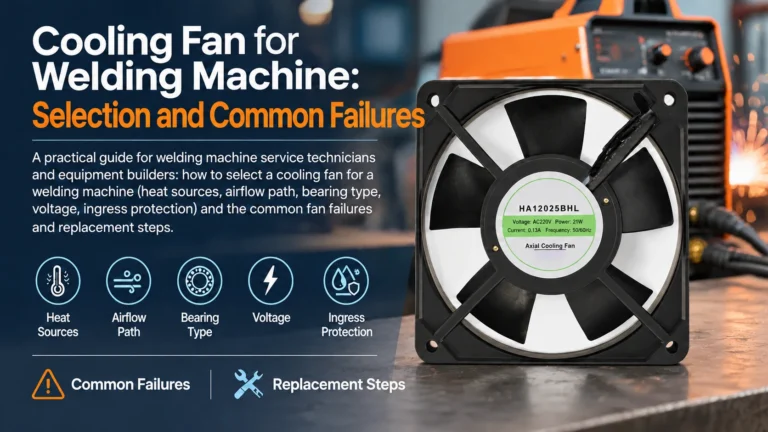
A practical guide to selecting and replacing a cooling fan for welding machine enclosures: heat sources, airflow path, fan specs, five common failures, and a step-by-step workshop swap.