A centrifugal fan is an air-moving device that draws air into the center of a rotating impeller and discharges it outward at roughly 90 degrees to the inlet. The impeller adds velocity to the air, while the surrounding housing converts part of that velocity into useful static pressure. This combination makes centrifugal fans well suited to ducted systems, filters, heat exchangers, and other applications that resist airflow.
You may also hear this equipment called a radial fan, centrifugal blower, or squirrel-cage blower. These terms sometimes overlap, but the exact name often depends on the wheel design, pressure range, and industry. This guide explains the basic operating principle, common blade types, typical applications, and the information needed to select a fan responsibly.
How Does a Centrifugal Fan Work?
Air enters through the fan inlet in a direction parallel to the shaft. A motor rotates the impeller, and the blades transfer mechanical energy to the air. The moving air travels from the center of the wheel toward its outer edge. It then enters a scroll-shaped housing, also called a volute, and leaves through a tangential outlet.
The volute becomes progressively wider around the wheel. This geometry collects air from the impeller and slows part of the flow, converting some velocity pressure into static pressure. The result is a steady flow that can overcome resistance created by ducts, bends, dampers, coils, filters, and process equipment.
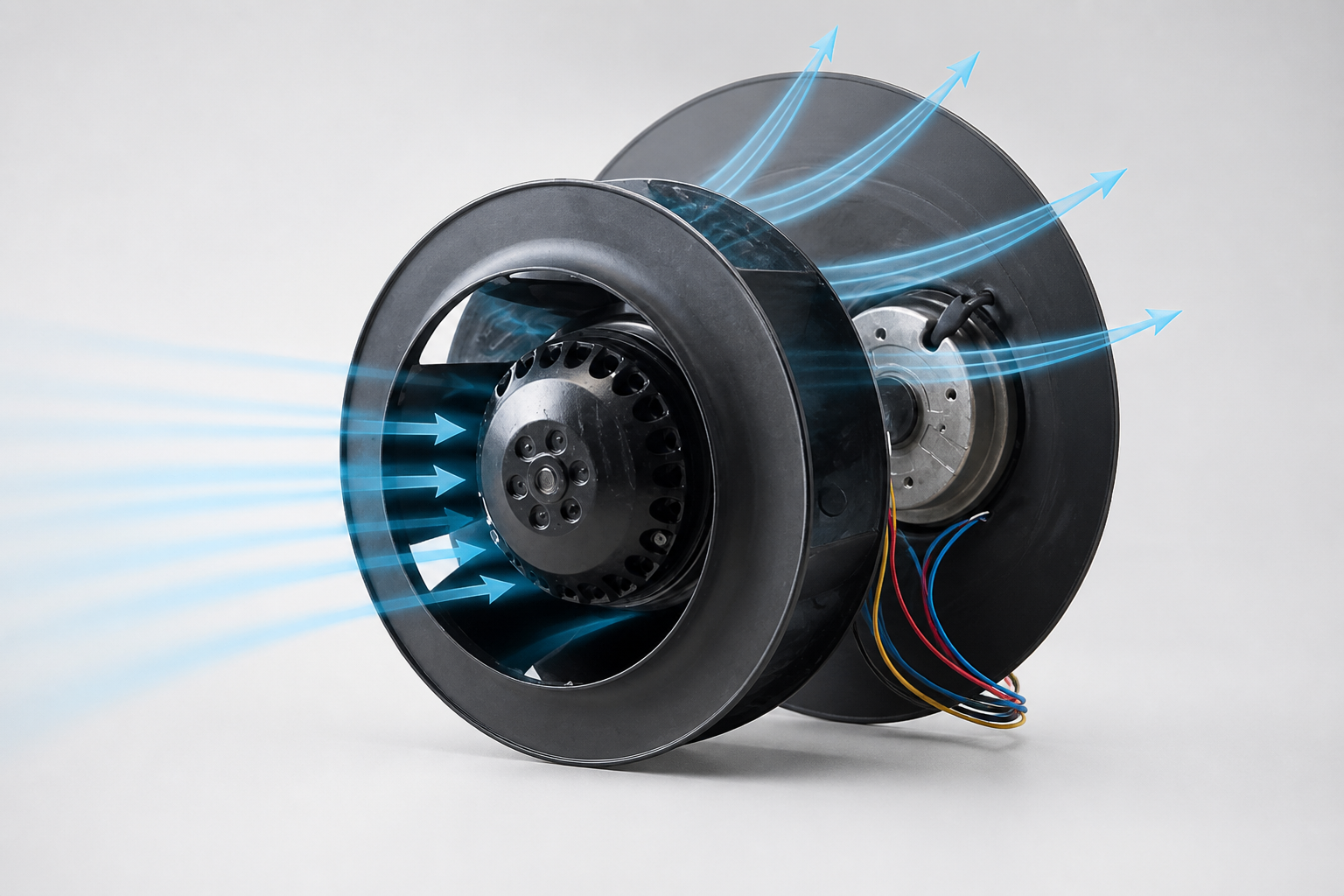
Main Components
- Impeller: The rotating wheel whose blades accelerate the air.
- Inlet: The opening that guides air toward the center, or eye, of the impeller.
- Volute or housing: The casing that collects the air and directs it toward the outlet.
- Motor and drive: The power source and transmission arrangement that rotate the wheel.
- Shaft, bearings, and supports: Components that keep the impeller aligned and rotating reliably.
- Outlet: The opening through which pressurized air enters the connected system.
The formal definition is based on airflow direction. According to the ANSI/AMCA fan terminology standard, air enters a centrifugal impeller essentially along its axis and leaves in a direction perpendicular to that axis.
What Are the Main Types of Centrifugal Fans?
Centrifugal fans are commonly classified by the direction and shape of their impeller blades. Blade geometry affects airflow, pressure, efficiency, noise, power demand, and the ability to handle contaminated air.
| Blade type | General characteristics | Typical uses |
|---|---|---|
| Forward-curved | Compact wheel, relatively high airflow at lower speed, usually for clean air | HVAC equipment, air handlers, furnaces, and compact ventilation units |
| Backward-curved or backward-inclined | Good efficiency, stable performance, and moderate-to-high pressure capability | Commercial HVAC, process ventilation, cooling, and energy-conscious systems |
| Airfoil | Streamlined blades designed for high efficiency in clean-air service | Large air-handling systems and continuous-duty clean-air applications |
| Radial blade | Strong, simple blades that tolerate some dust and material loading | Dust collection, material handling, and industrial exhaust |
| Radial-tip | Combines rugged construction with improved efficiency over basic radial wheels | Industrial process air and moderately contaminated gas streams |
These descriptions are general rather than universal specifications. Wheel diameter, width, rotational speed, housing design, materials, and motor selection all influence the final performance. Always compare manufacturer performance curves at the intended operating point.
Centrifugal Fan vs. Axial Fan
An axial fan moves air primarily in the same direction as its shaft, similar to a propeller. A centrifugal fan changes the direction of the flow and usually develops more static pressure for a given installation size. That difference helps explain why the two fan families serve different system needs.
| Selection factor | Centrifugal fan | Axial fan |
|---|---|---|
| Airflow path | Enters axially and leaves radially | Enters and leaves mainly along the axis |
| Pressure capability | Generally better for moderate or higher system resistance | Often preferred for high flow with low resistance |
| Installation shape | Scroll housing and a right-angle flow turn | Often compact in the airflow direction |
| Common applications | Ducted HVAC, filtration, process exhaust, and dust collection | General ventilation, condenser cooling, and free-air movement |
Neither design is automatically better. The correct choice depends on the required airflow, total system pressure, space, acoustic limits, air temperature, contaminants, efficiency target, and control method.
Where Are Centrifugal Fans Used?
Centrifugal fans appear wherever air or gas must move through meaningful resistance. Common applications include:
- Heating, ventilation, and air-conditioning equipment
- Air-handling units, furnaces, and rooftop systems
- Dust collectors, bag filters, and fume extraction systems
- Industrial drying, cooling, combustion air, and process exhaust
- Cleanrooms, laboratories, and controlled-pressure spaces
- Electronics cabinets and machinery cooling
- Agricultural aeration and material conveying systems
Application conditions matter as much as airflow. Hot gases may require special alloys, shaft cooling, or heat-resistant bearings. Corrosive air may call for coated metal, stainless steel, or engineered polymers. Dusty or particle-laden streams require a wheel and housing designed to resist buildup, erosion, and imbalance.
How to Select a Centrifugal Fan
A fan should be selected for a defined operating point, not by wheel diameter or motor power alone. Start with the system requirement and evaluate the complete fan curve.
- Define airflow. Specify the required volume in CFM, m³/h, or m³/s under stated air conditions.
- Calculate system pressure. Add the losses from ductwork, fittings, filters, coils, dampers, and connected equipment.
- Describe the airstream. Record temperature, humidity, density, corrosiveness, dust concentration, and particle characteristics.
- Choose a wheel type. Balance pressure, efficiency, cleanliness, noise, durability, and space.
- Check the performance curve. Confirm that the required duty point lies in a stable and efficient region.
- Verify power and speed. Make sure the motor can cover the expected load without being overloaded.
- Review sound and controls. Consider acoustic limits, variable-speed operation, dampers, and the expected range of demand.
- Confirm construction and certification. Evaluate materials, guards, vibration limits, ingress protection, and independently certified ratings where required.
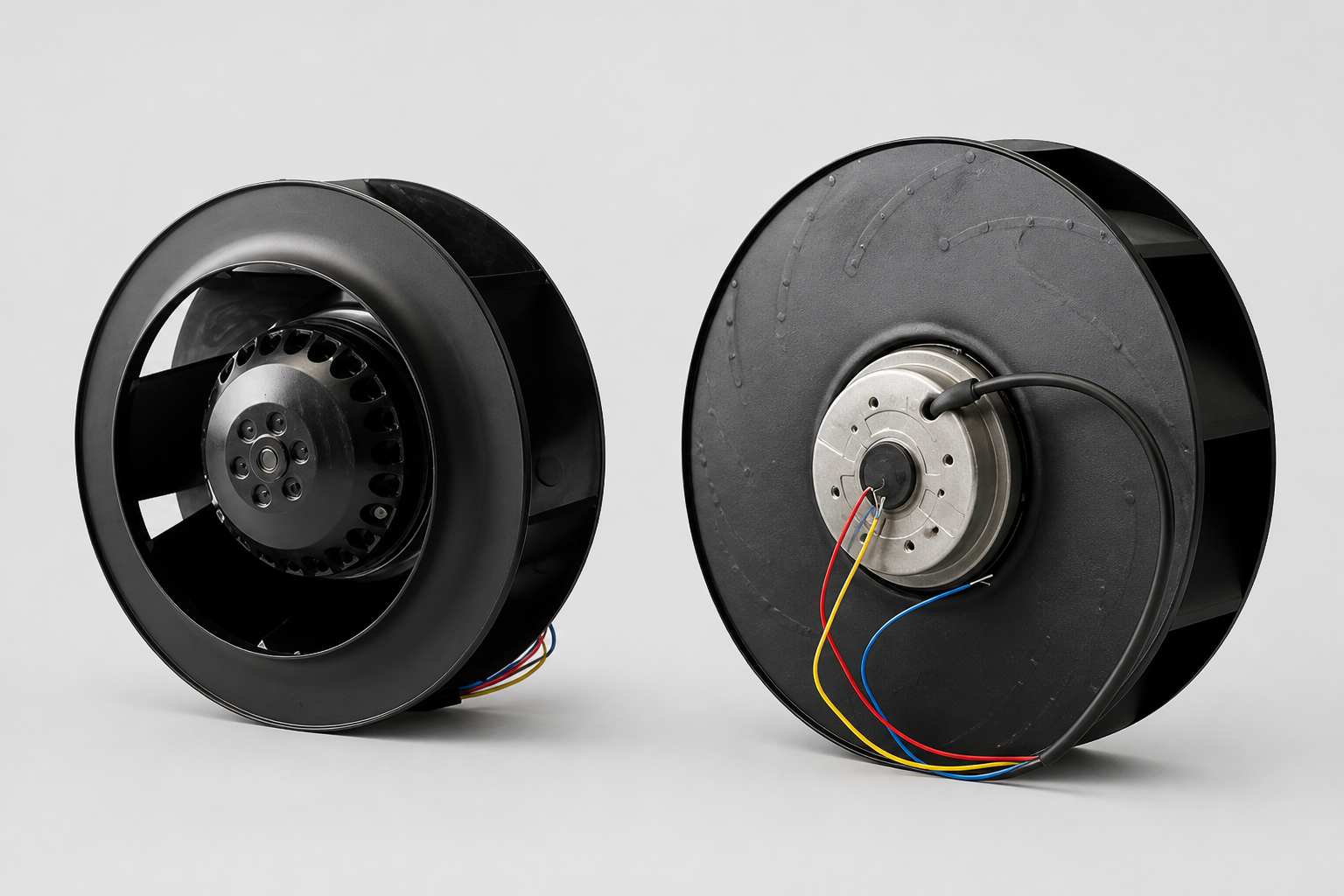
A key concept is the system curve: resistance generally rises as airflow increases. The fan operates where its performance curve intersects the system curve. Changing fan speed, opening a damper, or loading a filter shifts the operating conditions. For reliable comparisons, look for independently tested data such as products covered by the AMCA Certified Ratings Program.
Common Selection and Installation Mistakes
- Choosing by airflow alone: A free-air rating does not show how the fan performs against real system resistance.
- Ignoring density: Temperature and altitude can change the pressure and power relationship.
- Operating far from the efficient region: This may increase noise, vibration, energy use, or instability.
- Restricting the inlet: Poor inlet geometry can create swirl and uneven loading before air reaches the wheel.
- Placing an elbow directly at the outlet: Insufficient straight duct can cause system-effect losses.
- Using a clean-air wheel for dirty service: Deposits and erosion can reduce performance and damage the impeller.
- Skipping maintenance access: Bearings, belts, motors, and impellers need safe inspection and cleaning space.
Frequently Asked Questions
Why is it called a centrifugal fan?
The name describes the outward movement of air from the center of the rotating impeller toward its perimeter. In formal fan terminology, it is defined by air entering axially and leaving the impeller radially.
Is a centrifugal fan the same as a blower?
The words are often used interchangeably in everyday product descriptions. In engineering practice, “blower” may imply a machine designed for a higher pressure ratio than a fan. Confirm the actual pressure, airflow, and test data instead of relying on the label alone.
Can a centrifugal fan handle dust?
Some can. Radial-blade and other rugged industrial wheels are often designed for dusty streams, but particle size, concentration, abrasiveness, and buildup risk must be evaluated. Standard clean-air HVAC wheels should not be assumed suitable.
Can centrifugal fan speed be controlled?
Yes. Compatible motors can often be controlled with a variable-frequency drive or electronic controller. Speed changes affect airflow, pressure, and power, so the motor, fan, and system operating range must be checked together.
What information should I give a fan supplier?
Provide airflow, static or total pressure, air density or temperature and altitude, gas composition, contaminants, duty cycle, voltage and frequency, noise limits, space constraints, discharge orientation, and applicable safety or certification requirements.
Final Takeaway
A centrifugal fan uses a rotating impeller and housing to turn axial inlet flow into a pressurized radial discharge. Its ability to work against duct and equipment resistance makes it a practical choice for HVAC, filtration, cooling, exhaust, and industrial processes. The best fan is the one whose tested curve, wheel design, construction, and motor match the complete system—not simply the model with the largest airflow number.
If you are comparing fan options for a specific application, prepare your airflow, pressure, airstream, power, and installation requirements before contacting Yian Electric for a model-level assessment.