Axial Fan vs Centrifugal Fan: Which One Does Your Application Need?
Published: Author: Rachel
Choosing between an axial fan and a centrifugal fan looks like a matter of preference. It is really a constraint problem: the two impeller families move air in different directions, and that single fact sets their pressure, curve shape, noise, space and behaviour under resistance.
This guide is for engineers specifying a new installation and purchasers comparing quotes on an existing one. It works from the three physical differences that decide most selections, gives a duty-based decision table, then covers noise, efficiency, footprint, wear and drive arrangement. The aim is a defensible axial fan vs centrifugal fan decision.
Why the Airflow Path Decides Almost Everything
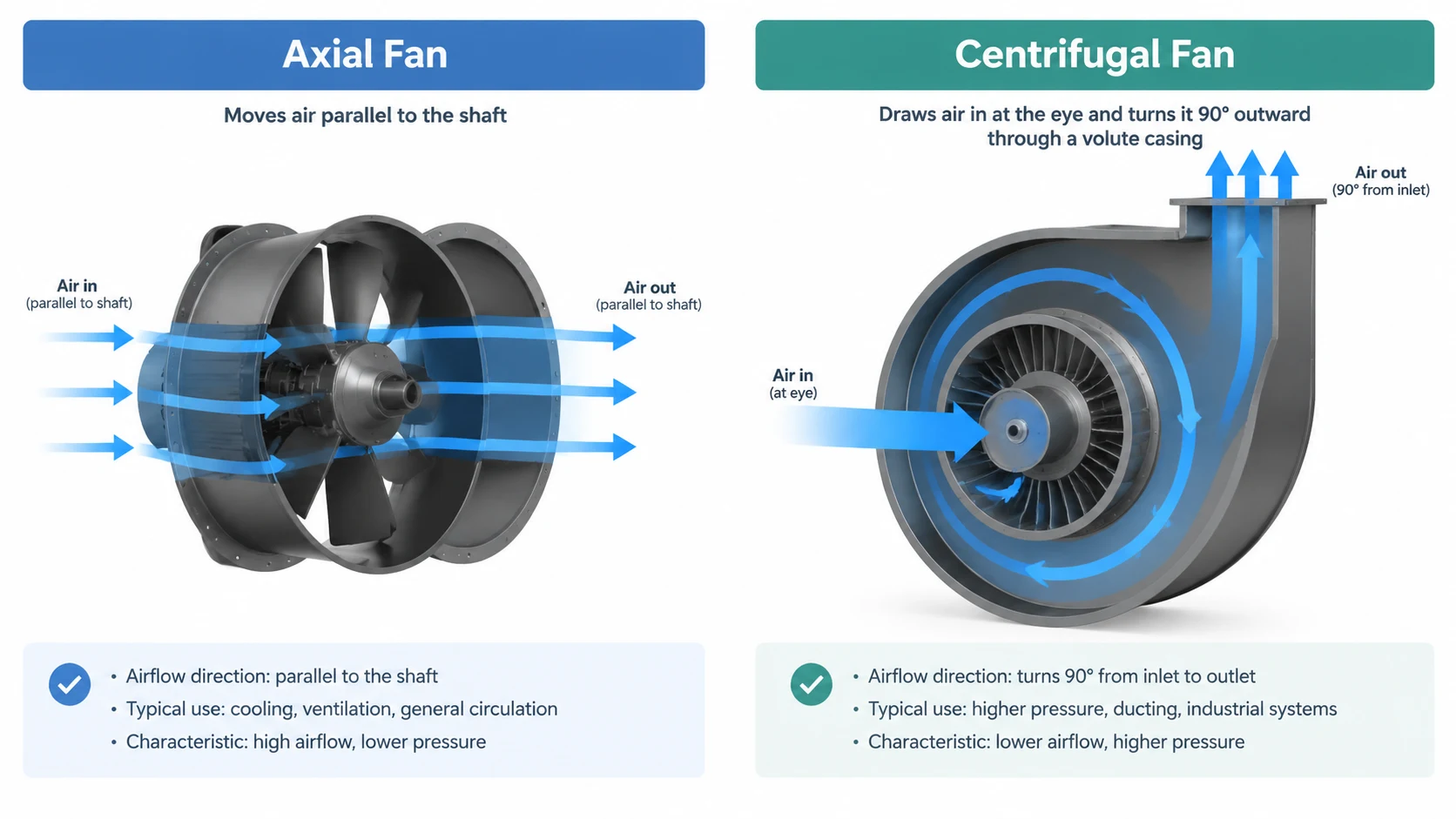
Every difference traces back to one question: does the air leave the impeller in the direction it arrived, or is it turned through a right angle and flung outward? Answer that and the axial fan vs centrifugal fan comparison is largely decided.
Axial Fans Push Air Parallel to the Shaft
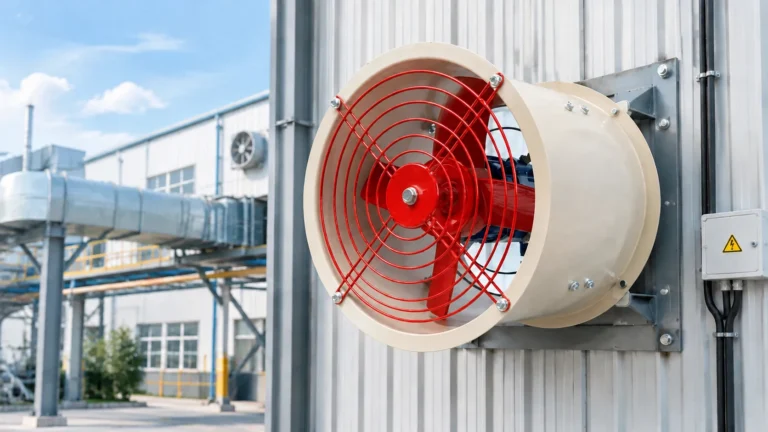
An axial fan draws air in and discharges it along the axis of rotation. The impeller resembles a propeller: blades set at a pitch angle on a central hub. Air travels nearly straight, keeping losses low when the path is open, but the impeller has only blade pitch and area with which to build pressure. Propeller, tube-axial and vane-axial types are covered in our guide to axial fan types.
Centrifugal Fans Turn Air Ninety Degrees Into a Volute
A centrifugal fan draws air in at the impeller eye, then accelerates it outward and turns it about 90 degrees into a spiral casing called a volute. The volute converts velocity into pressure as the casing expands. Pressure is generated as a byproduct of the very turn that costs an axial fan efficiency; see what a centrifugal fan is for the principle.
Where the Two Families Meet: Mixed-Flow Impellers
Between the extremes sits the mixed-flow, or diagonal, impeller: air enters axially but leaves at an angle between the axial and radial directions, giving more pressure than a pure axial in a more compact path.
The Three Physical Differences That Drive Selection
The families differ on three measurable points. Match those to your system and the selection is largely settled before you reach the cost column.
Difference 1 — Airflow Direction
Axial fans move air in a line, suiting an open path: a wall opening, a roof curb, a short duct or a free discharge. Centrifugal fans move air through a right-angle turn, suiting a hood, a duct run, a filter bank or a tight enclosure. Direction of flow is why one type tolerates resistance and the other does not.
Difference 2 — Static Pressure Capability
For a given impeller diameter and speed, a centrifugal impeller typically develops substantially more static pressure than an axial impeller. As a rough working figure, an axial fan’s useful static pressure is commonly a few hundred pascals, while a centrifugal fan of similar size can reach several times that. Confirm the figure for your model with the manufacturer.
Difference 3 — The Shape of the PQ Curve
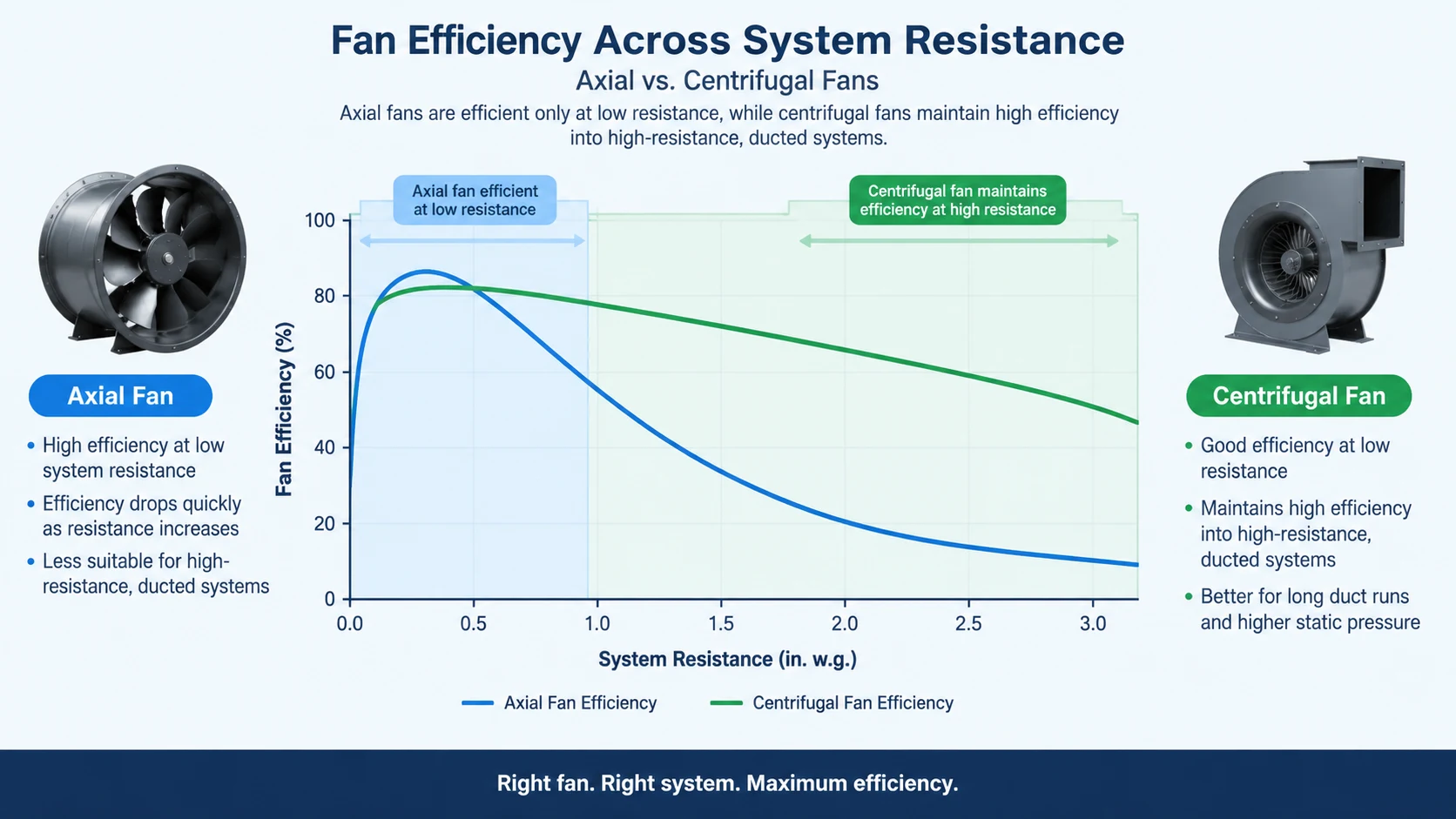
The pressure–volume (PQ) curve shows how much static pressure a fan develops at each airflow, and its shape decides whether the fan holds its duty. An axial fan’s curve falls steeply as resistance rises: generous flow at low pressure, but a low ceiling and a stall region where airflow can collapse while the fan still turns. A centrifugal fan’s curve is flatter and reaches much higher pressure.
Physical difference
Axial fan
Centrifugal fan
Airflow direction
Parallel to the shaft; nearly straight through
In at the eye, out radially through a volute (about 90°)
Static pressure capability
Low to moderate (typically a few hundred Pa)
Moderate to high (often several times an axial of similar size)
PQ curve shape
Steep; drops sharply with resistance, stall risk near the ceiling
Flatter; holds airflow up to much higher pressure
Effect of rising system resistance
Airflow falls quickly
Airflow falls less for the same resistance rise
A Decision Table: Matching the Duty to the Fan Type
Duty, not price, should drive the first decision. The table below maps common jobs to the family that fits them.
Low-Resistance, Large-Space Ventilation
General exhaust, heat relief in a high space, make-up air and air exchange in a warehouse or workshop are axial duties: short or absent path, high volume, low resistance. A large impeller turning slowly is the conventional answer, and a range such as our industrial axial fan line is built for it.
High-Resistance Ducts, Filters and Bends
Once the path includes long duct runs, elbows, dampers, filters or a captured hood, resistance dominates and the centrifugal family earns its bulk. A welding hood feeding a filter bank, dust collection, an air-handling unit or a boiler-room extract all need pressure to hold flow; a compact unit such as our power-frequency centrifugal fan is the type to compare.
Directional Delivery, High Temperature and Local Cooling
Where air must be aimed — spot cooling a heat sink, an air knife, a jet across a component — a centrifugal blower gives the concentrated, higher-pressure discharge a broad axial stream cannot. High-temperature flue or smoke extraction usually favours centrifugal, or a purpose-built high-temperature axial, because pressure and temperature both exceed a standard axial envelope.
Application
Recommended type
Why
Large-space exhaust or air exchange (open path)
Axial
Low resistance, high volume, straight-through efficiency
Long ducts, elbows, filters or dampers
Centrifugal
Holds airflow against high system resistance
Directional / long-distance delivery, air knives
Centrifugal (or mixed-flow)
Concentrated, higher-pressure discharge
High-temperature flue, smoke or process exhaust
Centrifugal, or a purpose-built high-temperature axial
Pressure demand plus temperature exceed a standard axial envelope
Local component or enclosure cooling
Axial for open paths; small centrifugal for tight paths
Space and back-pressure decide
Noise: How the Two Families Actually Differ
The axial vs centrifugal fan noise question is usually answered with a slogan — one type is quieter — but that holds only at matched operating points, which installations rarely share.
Axial Noise — Broadband Rush Plus a Blade-Passing Tone
Axial noise is aerodynamic: turbulence shedding off the blades and the rush of air through the guard, inlet and housing, heard as a hiss. On top sits a discrete tone at the blade-passing frequency, a whine whose pitch rises with speed. A large axial fan running slowly can be very quiet, but pushed against back-pressure it stalls, airflow detaches and a low-frequency buffeting appears.
Centrifugal Noise — Broadband Vortex and Volute Interaction
A centrifugal fan does not stall the way an overloaded axial does, so it stays more acoustically stable as resistance rises. Its noise is broadband too — vortex shedding in the volute and blade interaction with the cut-off — and at higher speed reads as a steadier hum than a buffeting roar.
What Changes the Noise More Than the Type Does
Tip speed, inlet condition, mounting and operating point move the sound level more than the family does. A fan with a clean, straight inlet is quieter than the same fan behind a crushed duct; a fan running with pressure margin is quiet, while one straining at its curve is loud regardless of type. Treat catalogue figures as a laboratory floor.
Efficiency Zones and Operational Energy Cost
Neither family is universally more efficient. Each works well in one zone and wastes energy outside it, and the running bill is set by where the duty sits.
Where Each Type Is Efficient
Axial fans are efficient in their home zone: high volume, low pressure, open path. Centrifugal fans are efficient when the system needs their pressure, and backward-curved impellers hold good efficiency across a range of resistance. The axial fan vs centrifugal fan efficiency question is decided by the duty, not the label.
Why Off-Design Operation Costs More Than the Nameplate Suggests
Energy use follows the operating point, not the motor nameplate. A modest fan running permanently at the far left of its curve can consume more than a larger fan at its design point, because power scales steeply with speed. Cost is set by how far the duty sits from the efficiency zone.
When Speed Control Beats a Change of Type
If system resistance varies — a loading filter, a process running at different rates — variable-speed control lets the fan follow the duty instead of fighting it, and power falls sharply with speed. Our comparison of AC and DC axial fans covers supply and control. It does not change which family is right, but often which is cheaper to run.
Footprint, Installation and Cost Structure
Space and cost decide many selections once the duty is understood, and the families differ sharply on both.
Straight-Through Mounting Versus a Scroll Housing
An axial fan is compact, often nearly flat, so it fits a wall panel, roof curb or frame with minimal depth and can mount inline in a duct. A centrifugal fan needs room for its scroll housing and inlet, and its discharge turns through 90 degrees, so depth and outlet direction must both be planned.
Space for Duct Connections and Service Access
Plan access before approval. Dirty blades reduce airflow and raise motor load, and a fan you cannot reach will quietly lose performance. Centrifugal units need clearance around the housing and a straight inlet run; a compact axial with no room to clean the impeller trades convenience for a later maintenance problem.
What Drives the Purchase and Lifetime Cost
The axial fan is usually the simpler, lower-cost unit: less material, lighter build, straightforward mounting. A centrifugal fan costs more up front — housing, heavier impeller, more robust motor — but lifetime cost also adds energy, maintenance access, spares and downtime.
Maintenance, Wear and Service Life
Service life is driven by duty conditions more than by the family label, but the two types wear differently.
Contaminant Tolerance and Self-Cleaning Behaviour
Radial-bladed centrifugal impellers are the robust choice for dirty exhaust and dust collection, because contamination does not cling to a straight blade as it does to a fine airfoil. Axial impellers with fine blades can load unevenly in heavy dust, which quickly becomes an imbalance problem. Match the blade shape to the contamination.
Bearing Load, Balance and What Wears First
On both types the usual first failure is the bearing, then imbalance from dust deposits or blade damage. Centrifugal impellers are heavier and run slower with higher torque, loading bearings differently from the faster, lighter axial rotor. Imbalance is the most avoidable wear mechanism.
Access for Cleaning and Repair
Set the maintenance plan at selection. Fans in continuous dirty duty need an inspection interval, an isolation method and clearance to remove the impeller if required. A well-chosen fan with poor access will underperform a slightly less ideal fan that can be cleaned on schedule.
Drive Arrangements: Belt, Direct and the Real Trade-Off
Drive arrangement is a separate decision from impeller type, but it interacts with it strongly.
Direct-Drive Arrangements
A direct-drive fan couples the impeller to the motor shaft, or mounts the impeller on the motor itself. There is no belt to tension or replace, alignment is fixed at manufacture and the assembly is compact. It suits clean, moderate duty and small equipment — but fan speed is tied to motor speed unless a variable-speed drive is fitted.
Belt-Driven Arrangements
A belt drive transmits power through pulleys, letting fan speed be set independently of the motor by changing pulley ratios. That flexibility suits duties that are uncertain or likely to change, and it keeps the motor out of a hot or dirty airstream. The cost is an extra maintenance item: belts need correct tension and alignment.
Which to Specify for Dust, Heat and Speed Changes
For dusty or high-temperature duty, a belt drive that keeps the motor outside the hot or dirty stream is often more durable, at the cost of belt maintenance. For clean duty at fixed speed, direct drive is simpler. Where the duty will change, speed control on either arrangement usually beats changing pulleys.
Common Misapplications and How to Spot Them
Most selection failures are one of three familiar mistakes, and each leaves a recognisable signature in service.
Using an Axial Fan to Push a High-Resistance Duct
Fit an axial fan where the system needs pressure and the free-air rating looks ample, but in service the duct delivers little more than a draught. The signature is a fan that runs normally and sounds busy yet fails its airflow check, because the operating point has slid along a steep axial curve into stall. Re-select for the real pressure.
Using a Centrifugal Fan for Large-Space Ventilation
The mirror error is a centrifugal fan on a large open space that needs volume, not pressure. It works, but spends energy turning air through a scroll it did not need, and its higher cost and footprint buy pressure the system never uses. A large, slow axial fan would deliver the same air exchange for less energy.
Sizing on Free-Air Flow Instead of the Duty Point
Underneath both mistakes is one root cause: selecting on the free-air rating instead of the flow at the actual system resistance. Guards, louvres, filters, bends and duct length all add resistance and move the operating point away from free air. Specify airflow at the pressure the installed system will present.
Misapplication
Field symptom
What to do instead
Axial fan on a high-resistance duct
Fan runs normally, airflow far below free-air rating
Reduce resistance or re-select a centrifugal fan for the real pressure
Centrifugal fan for large-space ventilation
Target airflow met but higher running cost and footprint
Use a large, slow axial fan for the open, low-resistance duty
Sizing on free-air flow
Installed airflow lower than expected; noise and load higher
Specify airflow at the system’s actual resistance, not in free air
A Three-Step Selection Method
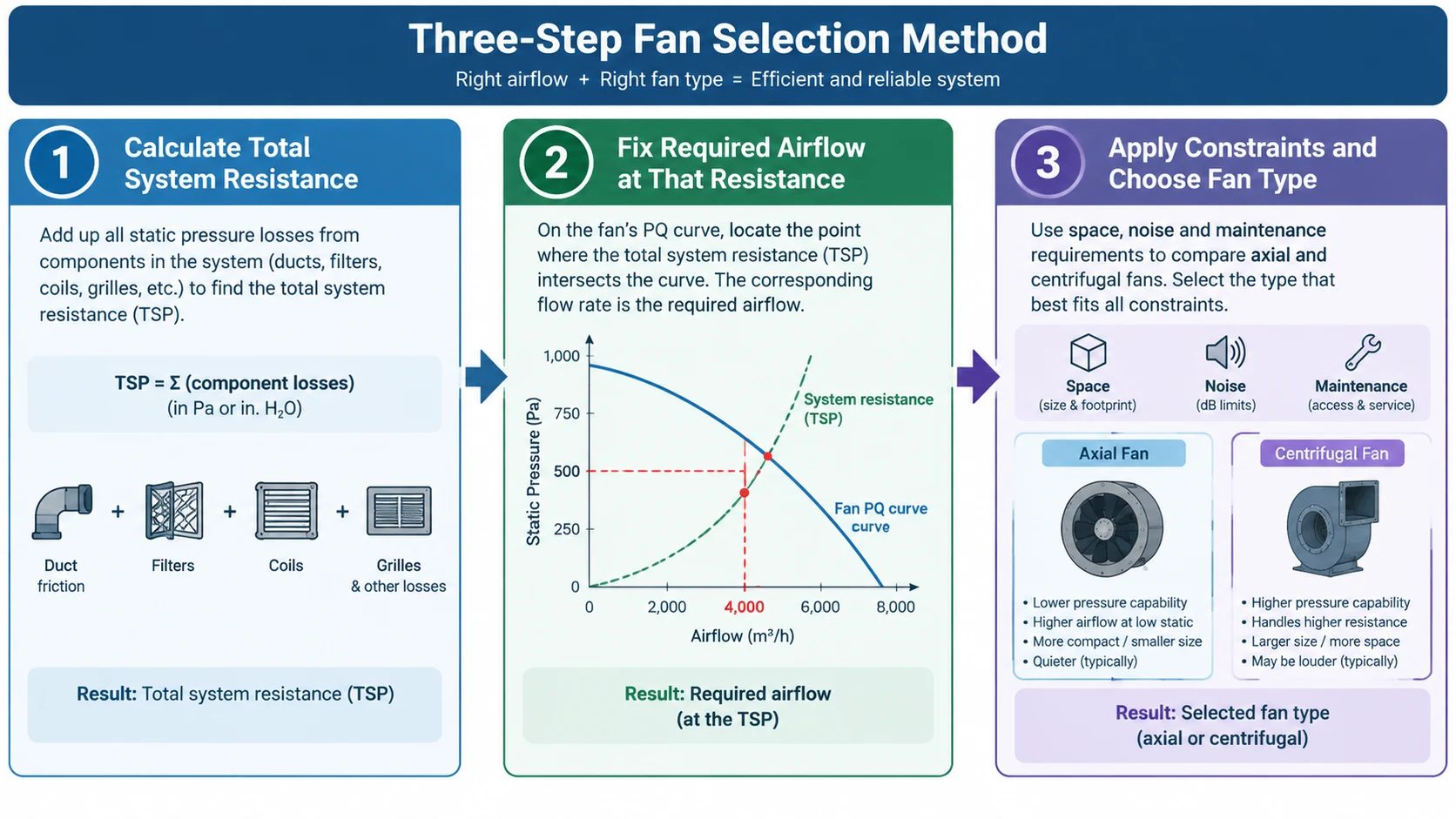
Work the problem in one order and the choice usually settles itself: match the axial fan vs centrifugal fan decision to the resistance first, size the airflow against it second, and apply the practical constraints last.
Step 1 — Estimate the Total System Resistance
Add up every source of pressure loss: guards, louvres, filters, dampers, bends, duct length and any hood. The total is your required static pressure, and it separates the two families. A low total puts the axial family in scope; a high or rising total points towards centrifugal. It is often understated at the quoting stage.
Step 2 — Fix the Required Airflow at That Resistance
With the resistance known, state the airflow you need at that pressure, not in free air. Check both candidates on their PQ curves: does each deliver that airflow where its curve crosses the system curve? This is where an axial fan can be ruled out despite a generous free-air rating. Ask for the operating point, not the peak figures.
Step 3 — Apply the Space, Noise and Maintenance Constraints
Finally, filter the survivors on installation space, duct connections, acceptable noise at the nearest occupied position, drive arrangement and maintenance access. This is where cost belongs too — purchase price together with expected energy and maintenance over the duty cycle. If a fan fails Step 3, revisit the layout.
Frequently Asked Questions
What is the difference between an axial fan and a centrifugal fan?
The core difference between axial fan and centrifugal fan designs is the direction of travel. An axial fan moves air parallel to its shaft, straight through, efficient at high volume and low pressure. A centrifugal fan draws air in at the impeller eye and flings it outward through a volute, building much higher static pressure to hold airflow against ducts, filters and bends.
Is a centrifugal blower better than an axial fan?
Neither wins outright; the centrifugal blower vs axial fan comparison can only be settled against your duty. A centrifugal blower is better when the system is restrictive — long ducts, filters, dampers or a captured hood — because it maintains airflow where an axial fan would stall. An axial fan is better for open, low-resistance work such as general exhaust.
Which is quieter, an axial fan or a centrifugal fan?
The honest answer to the axial vs centrifugal fan noise question is that it depends on the operating point, not the family. A large axial fan running slowly in free air is very quiet; the same fan straining against back-pressure stalls and produces an irritating low-frequency buffeting. A centrifugal fan is generally acoustically stable at low resistance, though a high-speed unit can carry a higher baseline level.
Is a centrifugal fan the same as a propeller fan?
No — the centrifugal fan vs propeller fan distinction is essentially the same as centrifugal versus axial. A propeller fan is an axial fan: its blades push air straight through along the shaft, and it is a high-volume, low-pressure device. A centrifugal fan turns the air through a volute and builds far higher pressure. Confirm the impeller type and the PQ curve.
Can I use an axial fan where a centrifugal fan is specified?
Only if the system resistance is genuinely low. Swapping in an axial fan for a centrifugal duty usually means the fan turns at full speed while the duct delivers far less air than required, because the axial curve falls steeply as resistance rises. If a quotation proposes an axial fan for a ducted, filtered or hooded application, ask for the delivered airflow at the system’s actual static pressure.
What to Confirm With the Manufacturer Before You Order
The right fan is the one whose curve crosses your system curve at the airflow you need, with enough margin to hold that duty as conditions change. Bring three numbers to the conversation: your required airflow, your estimated total system resistance, and your space, noise and maintenance constraints. Ask for the operating point on the PQ curve, not the free-air rating; and ask which impeller and blade shape suits your contamination and temperature. A supplier who answers with your own system data, as our industrial fan selection guide sets out, will surface a mismatch before it is built in, and our small centrifugal blower guide covers the compact, restrictive case in more depth. Decide on the physics first, and the axial fan vs centrifugal fan choice becomes a calculation.
A symptom-first guide to an exhaust fan not working: five failure patterns, power, control and capacitor checks, bearing faults, air-path blockages, and how to match a replacement fan.
Industrial exhaust fan noise has three distinct families - aerodynamic, mechanical and electromagnetic - and each needs a different fix. This guide gives a five-step field diagnosis, then covers source-first remedies: speed reduction, balancing, bearings, vibration isolation, silencers and placement, with the airflow trade-offs made explicit.
A practical guide to selecting and replacing a cooling fan for welding machine enclosures: heat sources, airflow path, fan specs, five common failures, and a step-by-step workshop swap.