Sooner or later, anyone specifying ventilation for a chemical plant, fuel store, grain facility or tunnel project runs into the term. The question sounds simple — what is an ATEX rating? — but the honest answer involves two EU directives, six zones, three equipment categories and a marking string that looks like alphabet soup until you know the pattern.
This guide works through it from a fan buyer’s perspective: what the rating legally proves and what it does not, how zones turn into equipment categories, how to read the marking on a fan’s nameplate, and why fans carry their own additional construction standard. By the end you should be able to look at any Ex-marked fan and know exactly what you are looking at — and what to demand from a supplier before you sign.
What an ATEX Rating Actually Means
ATEX is short for ATmosphères EXplosibles, the French term for explosive atmospheres. In practice the word covers two pieces of European law rather than a single certificate. A fan described as “ATEX rated” has been designed, assessed and marked so that it will not act as an ignition source — no spark, no hot surface, no friction — in the specific kind of hazardous area it is certified for.
The Two ATEX Directives, and Who Each One Binds
The distinction between the two directives explains most of the confusion in procurement conversations, because each one puts obligations on a different party.
Directive
Common name
Binds
Core duty
2014/34/EU
ATEX Equipment Directive
Manufacturers
Design, test and mark equipment so it cannot ignite the atmosphere it is certified for
1999/92/EC
ATEX Workplace Directive
Site operators and employers
Assess the site, classify hazardous areas into zones, and select equipment to match
The practical consequence: zone classification is the operator’s legal job, not the supplier’s. A manufacturer can tell you what its fan is certified for, but only your own area classification tells you which zone your plant actually has. Suppliers who offer to “classify your zones for you” are stepping outside the framework — treat that as a warning sign, not a service.
What the Rating Proves — and What It Does Not
An ATEX rating is proof of one narrow thing: the equipment has been assessed so it will not ignite the surrounding atmosphere, even under defined fault conditions. It says nothing about how well the enclosure keeps water out, how it survives corrosion, or how tough it is mechanically.
ATEX rating
IP rating
Question it answers
Can this device ignite the atmosphere around it?
Can this enclosure keep dust and water out?
What it assesses
Sparks, arcs, hot surfaces, friction, static discharge
Ingress of solid objects and moisture
What it does not cover
Ingress, corrosion, impact resistance
Ignition risk of any kind
A fan can be sealed to IP66 and still be dangerous in a classified area if its motor runs hot or sparks. The reverse is also true: an ATEX fan with a poor ingress rating will not survive the washdown and weather that oil and gas sites routinely impose. Serious hazardous-area hardware carries both specifications, confirmed separately.
The Six ATEX Zones, and What Each One Demands
Zones describe how often an explosive atmosphere is present. The lower the number, the more often it is present, and the more the equipment must be able to tolerate. Gas zones and dust zones use parallel numbering — a two in front for dust.
Gas Zones: 0, 1 and 2
Zone 0 — an explosive gas atmosphere is present continuously, for long periods, or frequently. Think of the space inside a fuel tank or pipeline.
Zone 1 — likely to occur occasionally in normal operation: around pump seals, filling points, vent openings.
Zone 2 — unlikely in normal operation and short-lived if it occurs: a plant floor near a closed, well-maintained system.
Area classification practice commonly works with rough presence figures: more than 1,000 hours per year for Zone 0, between 10 and 1,000 for Zone 1, and under 10 for Zone 2. These are working guidelines for assessment, not legal definitions — the formal classification always comes from the site’s own risk assessment.
Dust Zones: 20, 21 and 22
Zone 20 — a combustible dust cloud is present continuously or for long periods: inside silos, mills and dust filters.
Zone 21 — likely during normal operation: bagging stations, transfer points, pouring operations.
Zone 22 — unlikely, and short-lived when it occurs: the floor area around a bag dump station or flour handling line.
Why Most Fans End Up in Zone 2 or Zone 22
In practice, the majority of classified industrial areas fall into Zone 2 or Zone 22. These are working areas where people and machines operate daily and the hazard is real but intermittent. That matters for budgeting as much as for safety: Category 3 equipment — the match for Zone 2/22 — is the least specialised and most widely available tier, and ventilation there is a materially different purchase from ventilation inside a tank.
How a Zone Turns Into an Equipment Category
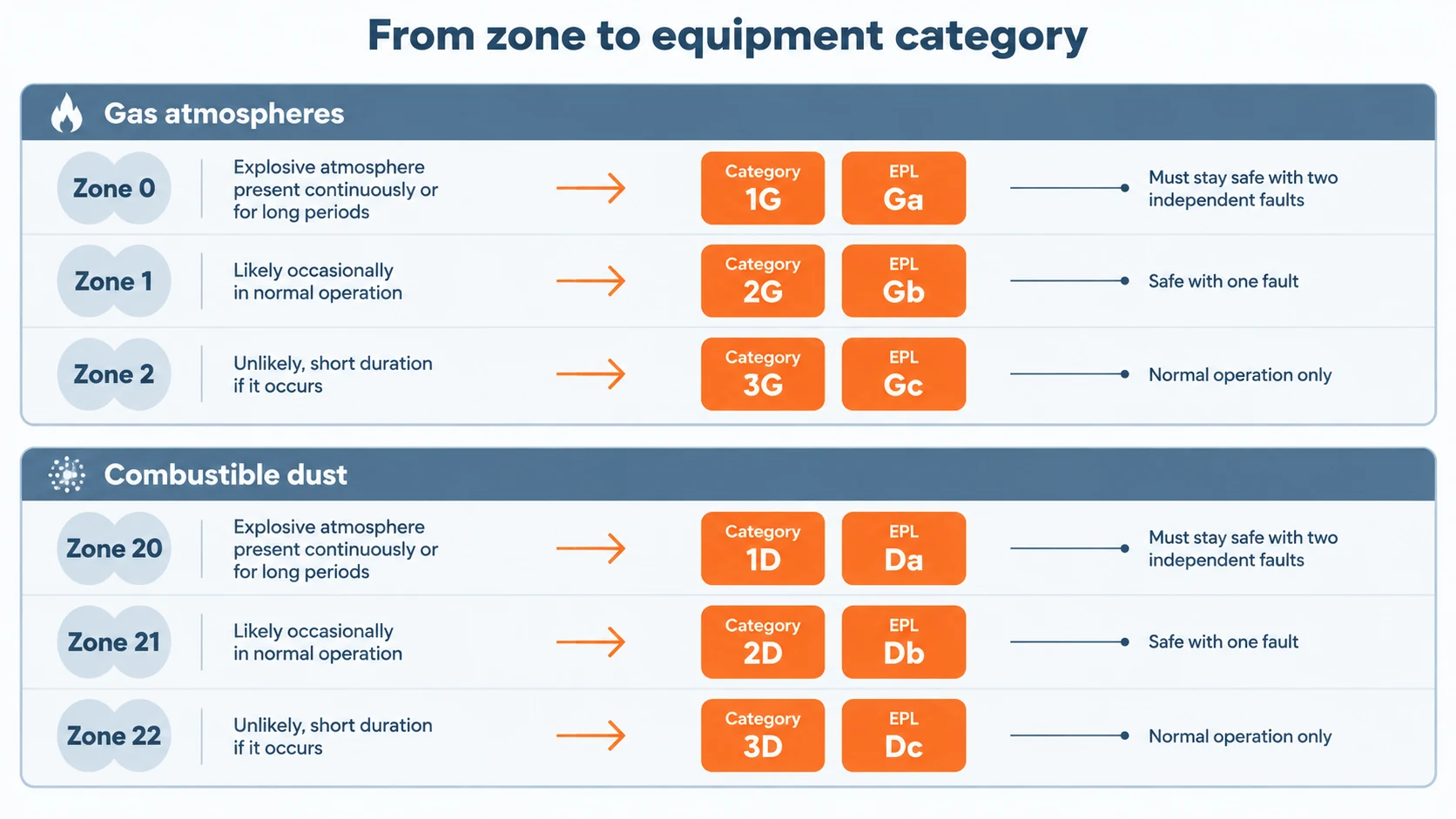
Once the zone is fixed, the equipment category follows almost mechanically. Categories describe how much fault tolerance the equipment must have.
Categories 1G, 2G and 3G, and the EPL Letters
Zone (gas / dust)
Presence
Category
EPL
Must remain safe with
Zone 0 / Zone 20
Continuous, long-term or frequent
1G / 1D
Ga / Da
Two independent faults
Zone 1 / Zone 21
Likely occasionally in normal operation
2G / 2D
Gb / Db
One fault
Zone 2 / Zone 22
Unlikely, short duration
3G / 3D
Gc / Dc
Normal operation only
Each zone maps to one equipment category and one Equipment Protection Level (EPL). The EPL letters Ga, Gb and Gc appear at the end of the Ex marking string.
Why Over-Specifying the Category Costs You
A Category 2 fan installed in a Zone 2 area will work, but you will pay a significant premium for fault tolerance the location does not demand, and the fan may be physically larger and harder to install. The reverse mistake is the dangerous one: a Category 3 fan in a Zone 1 area is not a conservative choice but a compliance failure. Match the category to the classified zone and treat every step up as a decision made by the risk assessment, not by the catalogue.
Gas Groups and Temperature Classes
The category says how reliable the equipment must be. Two further dimensions say what it must survive: the gas group and the temperature class.
Gas Groups IIA, IIB and IIC
Equipment group II covers all above-ground industries (group I is mining). Within group II, gases are subdivided by how easily an explosion propagates through a gap — the maximum experimental safe gap (MESG):
Gas group
Typical MESG
Representative gases and vapours
IIA
Above 0.9 mm
Propane, butane, petrol vapour
IIB
0.5–0.9 mm
Ethylene, diethyl ether
IIC
0.5 mm and below
Hydrogen, acetylene, carbon disulphide
The groups are cumulative in one direction only: a fan certified for IIC covers IIA and IIB gases as well, while an IIA-certified fan covers IIA gases alone. In practice most industrial sites involve IIA or IIB gases, and IIC-certified fans are a distinctly more specialised purchase.
Temperature Classes T1 to T6
The temperature class caps the maximum surface temperature the equipment can reach, including under fault conditions. It must always sit below the auto-ignition temperature of every substance present at the site:
Temperature class
Maximum surface temperature
T1
450 °C
T2
300 °C
T3
200 °C
T4
135 °C
T5
100 °C
T6
85 °C
Note the direction, because it trips people up: a higher T-number means a lower permitted surface temperature, so T6 is the most stringent class. A fan marked T4 (maximum surface 135 °C) can be used with any gas whose auto-ignition temperature is above 135 °C — every gas in classes T1 through T4. It must not be used with gases of class T5 or T6, whose auto-ignition temperatures sit below that figure.
Dust Groups IIIA, IIIB and IIIC
Dust hazards use group III: IIIA covers fibres and flyings, IIIB non-conductive dusts such as flour or milk powder, and IIIC conductive dusts such as graphite. Conductive dust is the demanding case, because it can bridge clearances and defeat the assumptions behind ordinary enclosures — which is why dust-rated equipment carries its own type of protection marking and, typically, a higher ingress rating.
How to Read a Fan’s Ex Marking
Every Ex-certified product carries a marking string on its nameplate. It compresses everything above into one line, and every element in it is a filter between the fan and your site.
Decoding a Full Marking String
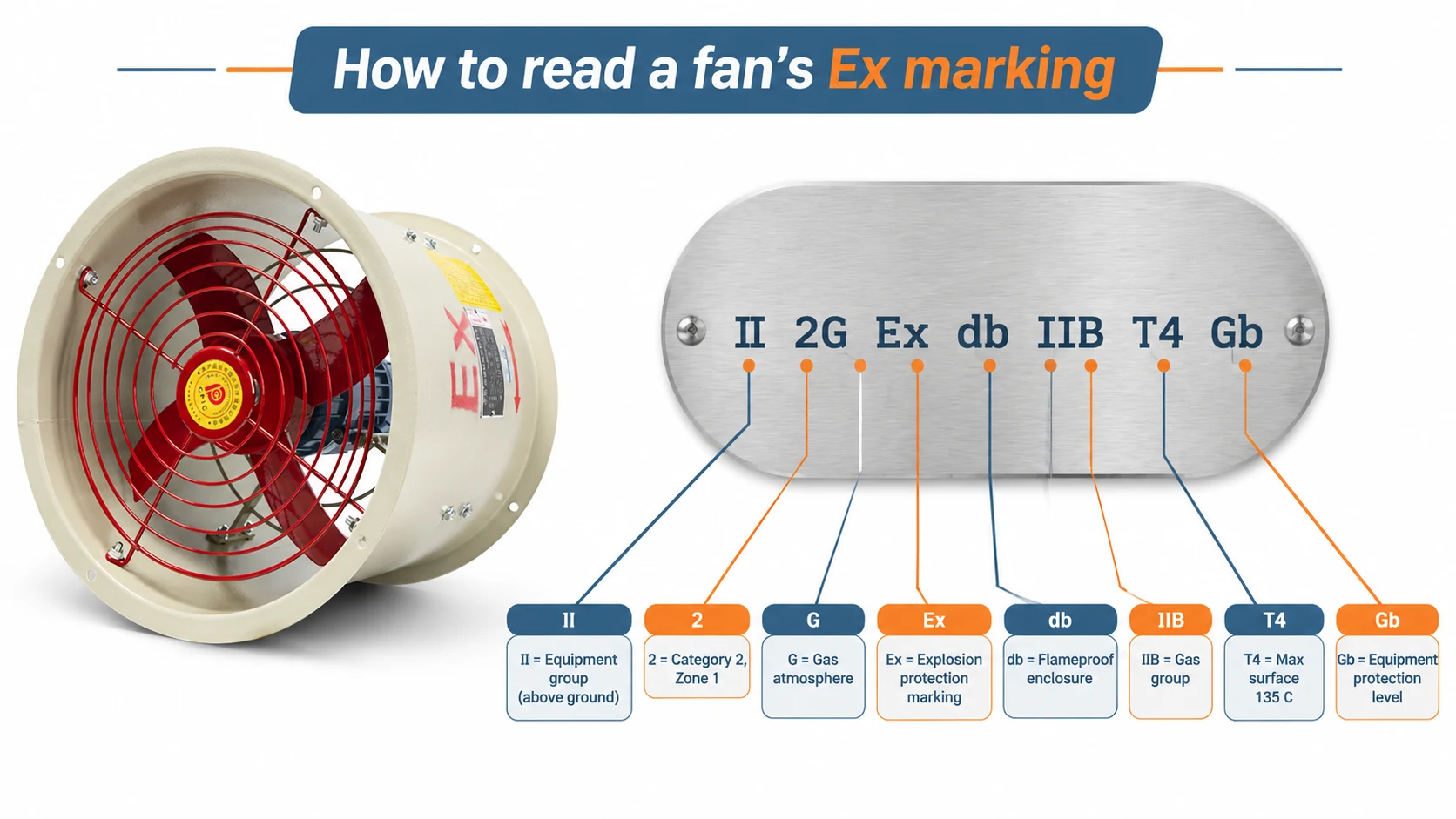
Take a common example: II 2G Ex db IIB T4 Gb.
Element
Meaning
II
Equipment group II — above-ground industries (I would mean mining)
2
Category 2 — suitable for Zone 1
G
Gas atmosphere certification (D would be dust)
Ex
Explosion protection marking
db
Type of protection: flameproof enclosure (older markings may show simply “d”)
IIB
Gas group
T4
Temperature class — maximum surface 135 °C
Gb
Equipment Protection Level
Anatomy of an Ex marking. If any single element does not match your site’s classification, the fan is not suitable — the rest of the string cannot compensate.
ATEX, IECEx and Chinese GB 3836 Markings
The Ex marking format itself comes from the IEC 60079 standard series, which several certification schemes share. That is why the string looks similar wherever the equipment was certified — but the scheme behind it is what decides where the fan can legally be installed.
Scheme
Where it applies
What you will see
ATEX
European Union
CE marking, Ex marking, EU-type examination certificate (notified body) for categories 1 and 2
IECEx
International — Australia, Middle East, Asia, South America
IECEx certificate and Ex marking; no CE requirement
GB 3836 series
China
Ex marking in the same format, certified under China’s national standard series aligned with IEC 60079
UKEX
Great Britain
UKCA/UKEX marking; mirrors ATEX technically
Because the underlying technical standard is shared, a fan marked Ex d IIB T4 that was certified under one scheme is not automatically certified under another. Before ordering, ask which scheme the certificate was issued under and whether it is recognised for your market — this single question avoids the most common cross-border procurement problem with hazardous-area equipment.
The Document That Matters More Than the Marking
The nameplate marking is only the visible end of the process. The legal proof is the certificate behind it. For Category 1 and 2 equipment, a notified body issues an EU-type examination certificate, and the body’s identification number appears next to the CE mark. Category 3 equipment may be self-declared by the manufacturer against the directive’s essential requirements, supported by a technical file.
Before signing, ask for three things: the certificate number (so you can verify it with the issuing body), the EU Declaration of Conformity, and confirmation that the marking on the actual nameplate matches the certificate. A supplier who can only offer the word “ATEX” on a datasheet has given you nothing verifiable.
Why Fans Are a Special Case: EN 14986
Most ATEX guidance is written around electrical equipment, where the ignition sources are sparks and heat from circuits. Fans are different: they add mechanical ignition sources that electrical standards do not address. EN 14986 is the European standard that sets construction requirements for fans intended for use in explosive atmospheres, and it is the reason a genuine ATEX fan is not simply a standard fan with a certified motor bolted on.
The Ignition Sources a Fan Adds
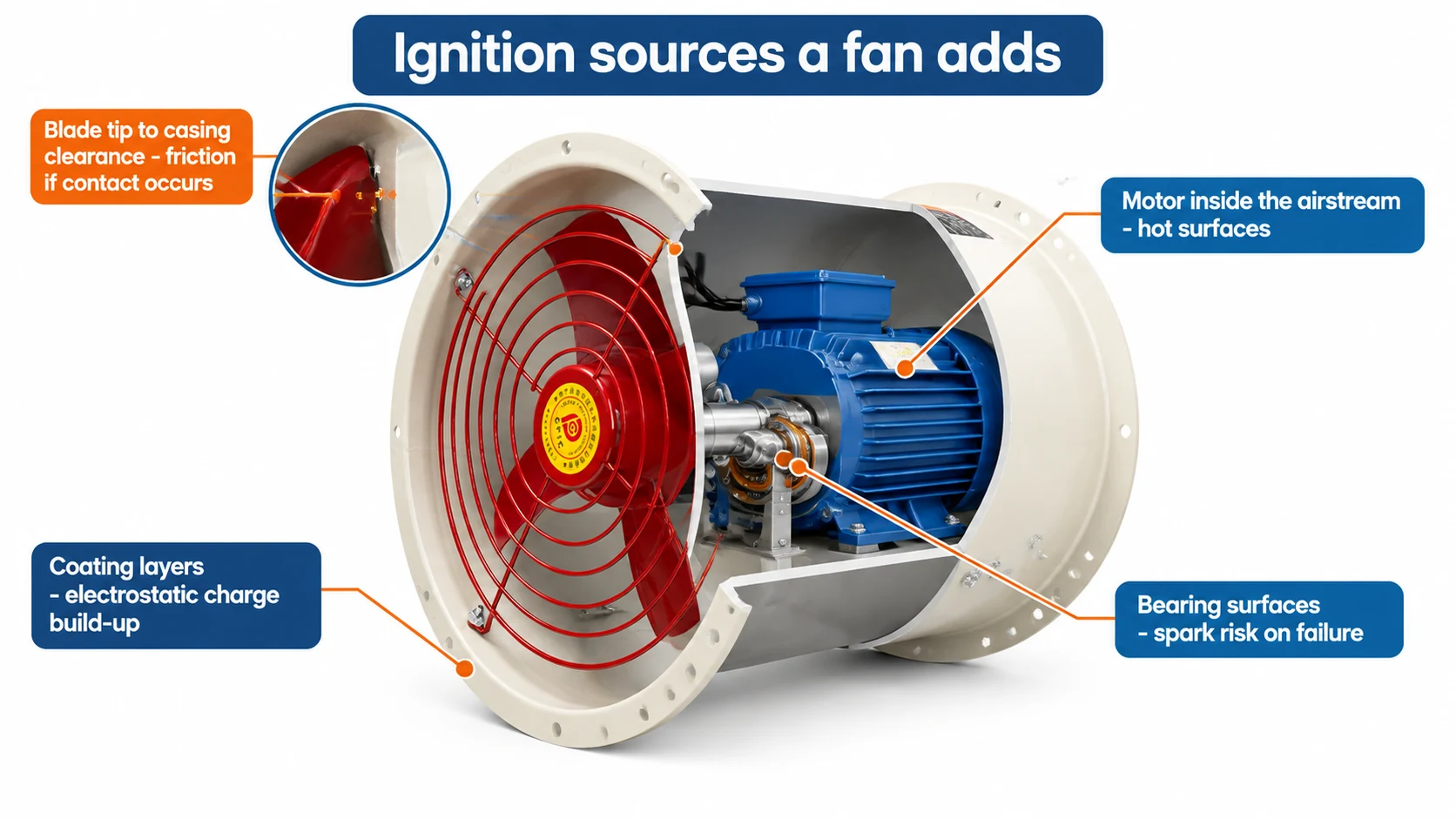
Friction between rotating and stationary parts — blade tips touching the casing after wear, or a shaft contacting its gland if a bearing fails.
Hot surfaces — motor windings and bearings; in many axial fan constructions the motor sits directly in the airstream.
Electrostatic discharge — from non-conductive coatings or plastic components that accumulate charge in a moving gas stream.
Sparks from foreign objects — debris striking an impeller at speed.
Ignition sources a fan adds on top of the electrical ones: blade-to-casing contact, a motor inside the airstream, bearing surfaces and static-charging coatings.
Blade Materials and the Clearance Rules
EN 14986 addresses these risks through the pairing of materials between rotating and stationary parts, minimum clearances, and rules for coatings. The pairing matters as much as either material alone: combinations that are safe when new can become hazardous as surfaces corrode or wear, which is why the standard specifies the combination rather than the individual components.
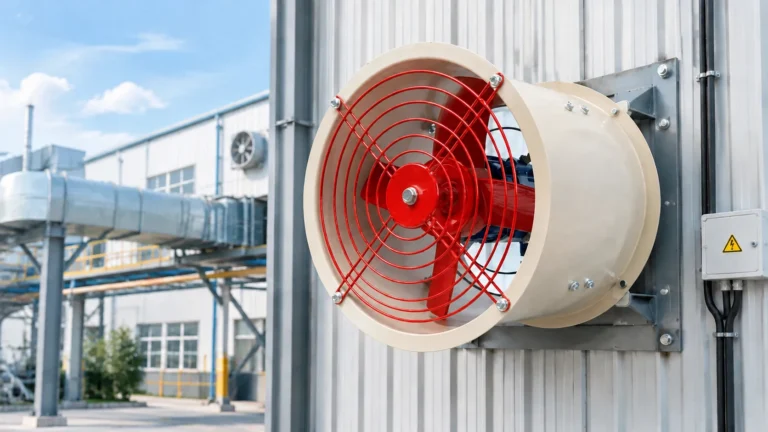
This is also why blade material is a legitimate selection criterion for buyers. Aluminium alloy blades paired with a compatible casing are a common spark-reducing construction in wall-mounted and duct-mounted explosion-proof fans — but the whole assembly, not the blade in isolation, is what earns the marking.
What This Means for Axial Fans
Axial fans deserve particular attention because many constructions place the motor inside the airstream — the electrical ignition risk sits in the same volume as the gas. Direct-drive designs avoid the static and friction questions a belt drive introduces, but they concentrate the electrical risk, which is why the motor usually carries its own Ex marking separate from the fan’s mechanical assessment. (If you need a refresher on how an axial fan actually moves air, we cover the basics separately.)
Expect the datasheet of a properly assessed ATEX fan to carry application limits alongside the marking — for example, a ceiling on the dust content of the medium, an ambient temperature range, or a minimum installation temperature tied to the impact testing of the casing. Read those limits as part of the certification, not as optional fine print.
From Zone to Purchase Order: A Worked Selection
Here is the sequence in practice, compressed into three steps.
Step 1: Start From the Area Classification, Not the Catalogue
Obtain three inputs from the site’s own assessment: the zone (for example Zone 2), the gas group (for example IIB), and the temperature class of the substances present (for example T3). If nobody on the buyer’s side can produce these three values, the project is not ready to purchase hazardous-area equipment — no fan specification can substitute for them.
Step 2: Fix the Category, Gas Group and Temperature Class
Worked example: the site classification says Zone 2, gas group IIB, substances in temperature class T3.
Zone 2 requires at least Category 3G (EPL Gc).
Gas group IIB requires equipment certified for IIB or better.
Substances of class T3 auto-ignite above 200 °C, so equipment marked T4 (maximum surface 135 °C) is acceptable — its surface stays well below the gas’s ignition point.
The resulting minimum requirement is II 3G Ex … IIB T4 Gc or better. Any fan whose marking meets or exceeds every element is eligible; any fan that falls short on a single element is not, regardless of price.
Step 3: Confirm the Construction and the Documents
With the specification fixed, the purchase decision becomes documentary: confirm the marking on the actual nameplate (not the datasheet) matches your requirement, obtain the certificate number and Declaration of Conformity, check that the motor’s Ex marking covers the drive, and read the application limits — ambient temperature, dust content of the medium, mounting orientation — against your installation.
Fans Rated for Zone 1 and Zone 2 Gas Atmospheres
Our explosion-proof ventilation range is built for the profile that covers most classified industrial sites: Zone 1 and Zone 2 gas atmospheres, gas groups IIA and IIB, temperature class T4 and above in the numbering. Before ordering, confirm the certification scheme and documents against your market’s requirements, as described above.
Assuming a CE mark means ATEX. CE marking on its own covers general product safety directives. Only the Ex marking and the certificate behind it cover explosive atmospheres.
Treating an IP rating as a substitute. A sealed enclosure controls ingress, not ignition. The two specifications answer different questions and hazardous-area equipment usually needs both.
Buying on the phrase “explosion proof” alone. The word is used loosely across the industry. Ask for the marking string and the certificate number — if a supplier cannot produce them, the rating is unverified.
Over-specifying the category. A Category 2 fan in a Zone 2 area works, but you pay a premium for fault tolerance the zone does not require, and installation gets heavier, not safer.
Ignoring the temperature class. A fan can be correctly zoned and correctly grouped and still be wrong for the site if its T-class exceeds the auto-ignition temperature of a substance present.
Expecting the supplier to classify the zones. Under the workplace directive, classification is the operator’s legal duty. A good supplier matches equipment to your classification; it cannot issue one.
Assuming the Ex marking covers the whole assembly. The motor often carries its own marking, separate from the fan’s mechanical assessment. Verify both, especially on direct-drive axial fans.
Frequently Asked Questions
What does ATEX stand for?
ATEX comes from the French ATmosphères EXplosibles, meaning explosive atmospheres. It refers to two EU directives: 2014/34/EU, which governs equipment for explosive atmospheres, and 1999/92/EC, which governs workplace safety where such atmospheres may occur. So when someone asks what an ATEX rating is, the short version is this: the marking plus the certificate that prove a specific device is safe for the zone it claims to serve.
Is “explosion proof” the same as ATEX?
No. “Explosion proof” is an informal industry phrase — and in North America it has a specific technical meaning under the NEC Class/Division system. ATEX is the European certification framework. A product can be described as explosion proof without being certified under any scheme, which is why the marking and certificate are what matter.
Can I use a Zone 2 fan in a Zone 1 area?
No. A Zone 2 fan is Category 3 equipment, assessed to remain safe in normal operation only. Zone 1 requires Category 2 equipment, which must also tolerate one fault. Installing the lower category in the higher zone is a compliance failure, not a conservative margin.
Does ATEX still apply in the UK after Brexit?
Yes, with adjusted paperwork. Great Britain’s DSEAR regulations carry over the workplace duties, and the UK’s UKEX scheme mirrors ATEX technically, built on the same EN 60079 standards. ATEX-marked equipment remains acceptable on the GB market.
What is the difference between ATEX and IECEx?
Both certify equipment against the IEC 60079 standards, so the Ex marking looks the same. ATEX is the EU legal framework and applies in Europe; IECEx is the international certification scheme used across Australia, the Middle East, Asia and South America. For multi-region projects, ask suppliers whether the same fan model carries both certificates.
How do I check that a fan is genuinely ATEX certified?
Three checks: read the marking string on the physical nameplate and confirm every element against your site’s classification; obtain the certificate number and verify it with the issuing notified body; and request the EU Declaration of Conformity. For Category 3 equipment, which may be self-declared, ask for the technical file reference and the manufacturer’s declaration in writing.
The Three Checks That Settle It
What is an ATEX rating, once the terminology is stripped away? A matching exercise. Your area classification gives you the zone, which fixes the category. Your site’s substances give you the gas group and temperature class. The marking string and the certificate behind it tell you whether a specific fan meets both. Get those three checks right and the label on the datasheet finally means what it appears to mean — and the fan you install is the one the hazard assessment actually called for.
A symptom-first guide to an exhaust fan not working: five failure patterns, power, control and capacitor checks, bearing faults, air-path blockages, and how to match a replacement fan.
Industrial exhaust fan noise has three distinct families - aerodynamic, mechanical and electromagnetic - and each needs a different fix. This guide gives a five-step field diagnosis, then covers source-first remedies: speed reduction, balancing, bearings, vibration isolation, silencers and placement, with the airflow trade-offs made explicit.
A practical guide to selecting and replacing a cooling fan for welding machine enclosures: heat sources, airflow path, fan specs, five common failures, and a step-by-step workshop swap.