How to Select a Cooling Fan for an Electrical Cabinet
Published: Author: Rachel
Selecting the right cooling fan for an electrical cabinet is one of the most
practical decisions an equipment designer, panel builder, or buyer can make.
A correctly sized cabinet cooling fan keeps contactors, drives, PLCs, and
power supplies inside their rated temperature window, prevents nuisance
tripping, extends component life, and avoids the field failures that lead
to warranty claims. This guide walks through the engineering process for
electrical cabinet cooling fan selection: from the first
question of “do I even need a fan?” to the airflow calculation,
AC/DC choice, intake/exhaust direction, static pressure, IP rating, and a
final selection checklist you can hand to procurement. It also compares
filter fans, heat exchangers, and cabinet air conditioners so you can pick
the right cooling technology for the environment, and ends with concrete
product options from the Small Axial Fan range.
New to cabinet thermal design? Read our broader
How to Select an Axial Fan for Industrial Applications
primer first; this article focuses on the sealed enclosure and IP-rated
use case, including filters, derating, and the trade-off between filter
fans and closed-loop cooling.
What Is an Electrical Cabinet Cooling Fan?
An electrical cabinet cooling fan is a small axial or centrifugal fan
installed on a control panel, distribution cabinet, or operator console
to move air through the enclosure. Its purpose is to remove the heat
generated by the components inside (variable frequency drives, soft
starters, power supplies, relays, PLCs, terminals) and reject that heat
to the outside ambient. The fan is mounted on a cut-out in the cabinet
wall, paired with a grille or filter mat on the opposite side.
Cabinet fans are grouped by frame size (80–250 mm is common
for panel work), voltage (AC 110/220 V, AC 380 V for larger
frames, or DC 12/24/48 V for battery and solar cabinets), and
duty. For most general-purpose industrial cabinets an axial fan is
preferred because the static pressure inside a filtered enclosure is
low (usually < 100 Pa) and axial fans deliver more airflow
per watt than centrifugal blowers at that pressure.
Why Electrical Cabinets Need Forced-Air Cooling
Almost every electrical component has a maximum ambient operating
temperature. For most industrial electronics that limit is 40 °C
or 55 °C with derating. Inside a sealed IP54/IP65 steel
enclosure the air temperature rises quickly once drives, transformers,
and power supplies start working. Even 100 W of losses in a
0.5 m³ enclosure will push the internal air 10–15 K
above ambient with no airflow, and condensation or overtemperature
follows.
Forced-air cooling keeps internal temperature below the component
rating so MTBF is preserved, prevents hot spots that cause early
capacitor failure, and reduces humidity by mixing — useful when
a cabinet cycles between cold night ambient and warm daytime
operation.
When Is a Cooling Fan Required?
A fan is required whenever internal heat losses, ambient temperature,
and enclosure surface area would push the internal air above the
lowest-rated component maximum. You almost always need forced-air
cooling when:
Total internal heat dissipation exceeds 50 W in an enclosure smaller than 1 m³.
The cabinet houses a VFD, soft starter, or servo drive of more than ~2.2 kW.
Ambient temperature at the cabinet regularly exceeds 35 °C.
The cabinet is sealed to IP54 or higher with no convection path.
Solar load heats the cabinet skin above 50 °C during the day.
If the enclosure is very small, lightly loaded, or naturally
ventilated, convection alone may be enough. Otherwise calculate the
required airflow using the method below.
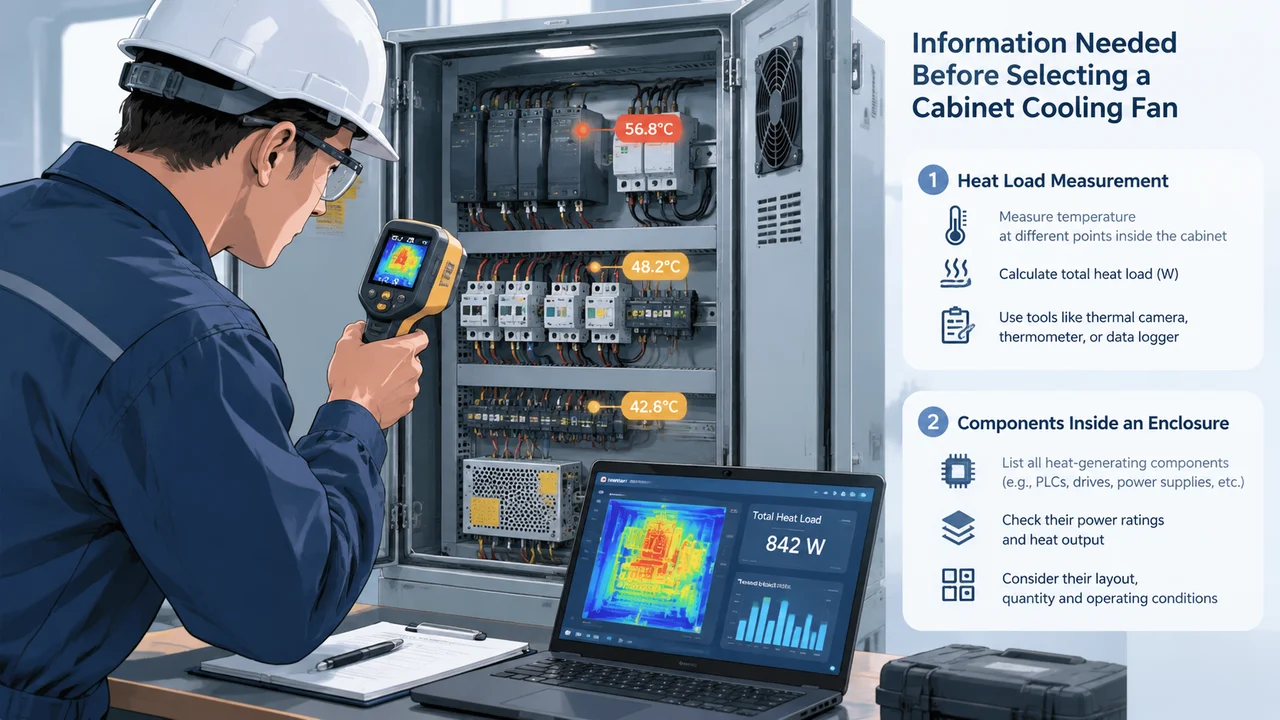
Information Needed Before Selecting a Cabinet Cooling Fan
Before you choose a fan, gather the following inputs. Each one
influences the final selection; missing any of them usually leads to
undersizing or oversizing.
Total internal heat loss (W) — sum of VFD losses, power supply losses, transformer losses, and an allowance for I²R in busbars.
Maximum ambient temperature (°C) at the cabinet, including sun load.
Maximum allowable internal temperature (°C) , usually the lowest component rating minus a 10 K safety margin.
Cabinet internal volume (m³) — used to check for airflow short-circuiting.
Available supply voltage — AC 110/220/230 V, AC 380 V three phase, or DC 12/24/48 V.
Air inlet configuration — filter mat, louver, or shielded grille (each adds a different static pressure).
Required IP rating — drives whether you can use a filtered inlet or need a closed-loop system.
Ambient air quality — dust, oil mist, humidity, chemicals, salt spray.
Noise constraint at the installation site.
Service life and maintenance plan — filter mats need cleaning; ball-bearing fans have longer life than sleeve-bearing fans.
How to Calculate the Required Airflow
Airflow is calculated from heat load, allowable temperature rise, and
air properties. The most common simplified formula for cabinet
cooling is:
Q = 3.1 × P / ΔT
Where:
Q = required airflow in m³/h
P = total heat dissipated inside the enclosure in W
ΔT = allowable temperature rise (internal max minus ambient) in K
3.1 = conversion factor combining air specific heat (~1.005 kJ/kg·K) and density (~1.2 kg/m³) at standard conditions, divided by 3600 to convert to hours
Worked Example
Wall-mounted cabinet with the following heat sources:
One 5.5 kW VFD at ~3% loss = 165 W
24 V DC power supply, 150 W output at ~85% efficiency = 26 W loss
Small PLC and I/O modules = 20 W
Busbars, wiring, terminals = 30 W
Total heat loss P = 165 + 26 + 20 + 30 = 241 W.
Maximum ambient = 40 °C. The lowest component rating inside is
the VFD at 55 °C with derating, so we use 55 °C as
the internal ceiling and apply a 10 K safety margin: target
internal temperature = 45 °C. Allowable ΔT = 45 −
40 = 5 K.
Q = 3.1 × 241 / 5 = ~149 m³/h.
Add a safety factor of 1.2–1.5 for filter clogging, altitude,
and summer peaks: 149 × 1.3 = ~194 m³/h.
Round up to the next standard fan size. A 172 mm frame axial fan
delivering 220 m³/h through a filter mat at 50 Pa is a
typical match for this load.
Send us your heat-load calculation and our engineers can specify a
fan model, supply voltage, and filter configuration for your exact
cabinet. Contact the Yian Electric team for a no-obligation review.
Adjusting the Formula
At high altitude (> 1500 m) air density drops ~10%, so
airflow must rise ~10% for the same cooling. The constant 3.1 in the
formula assumes standard sea-level density; if your site is at
altitude, divide by the local density ratio or just add 10–15%
to the final airflow.
How to Choose the Correct Fan Size
Match the calculated airflow to a fan size that delivers it at the
expected static pressure. Standard axial fan frame sizes for cabinet
work are 80 mm, 92 mm, 120 mm, 150 mm,
172 mm, 200 mm, and 250 mm. Larger sizes move more air
at the same pressure and run quieter per unit airflow, but they need
more cut-out space and can be harder to fit on a small door.
A typical sizing guide: up to 100 m³/h — 80 to
120 mm frame; 100 to 300 m³/h — 150 to
172 mm frame; 300 to 800 m³/h — 200 to
250 mm frame. Above 800 m³/h consider multiple smaller
fans or a larger external rotor fan.
Check the fan curve carefully: the rated airflow is at zero static
pressure. With a filter mat and grille you will lose 30–50% of
the free-air rating. Always pick the fan from its curve at the real
operating point, not from the headline free-air value.
AC vs DC Cabinet Cooling Fans
Both AC and DC fans are used in cabinets; the choice depends on the
available supply and the application. We have a detailed comparison in
our AC vs DC Axial Fan
article; the short version:
AC fans — single-phase 110/220/230 V or three-phase 380 V. Simple to wire (just connect to the cabinet supply), no driver needed, suitable for most industrial panels.
DC fans — 12 V, 24 V, or 48 V. Common in solar inverter cabinets, battery, telecom, and vehicle cabinets; usually offer wider speed control via PWM or 0–10 V.
Choose AC when the cabinet has a stable mains supply and you want the
simplest installation. Choose DC when the cabinet runs on batteries or
solar, when you need precise speed control for noise/cooling balance,
or when the supply voltage is already DC. Yian Electric’s
Small AC Fan
and
Small DC Fan
ranges cover the most common panel sizes from 80 mm to 172 mm.
Intake Fan vs Exhaust Fan
A cabinet usually needs both an intake and an exhaust path. The
question is which side gets the powered fan.
Intake fan — pushes filtered outside air into the cabinet. Better when ambient is dusty and you want the filter on the suction side.
Exhaust fan — pulls air out of the cabinet, drawing ambient air in through a passive grille or filter on the opposite side. Better when ambient is clean.
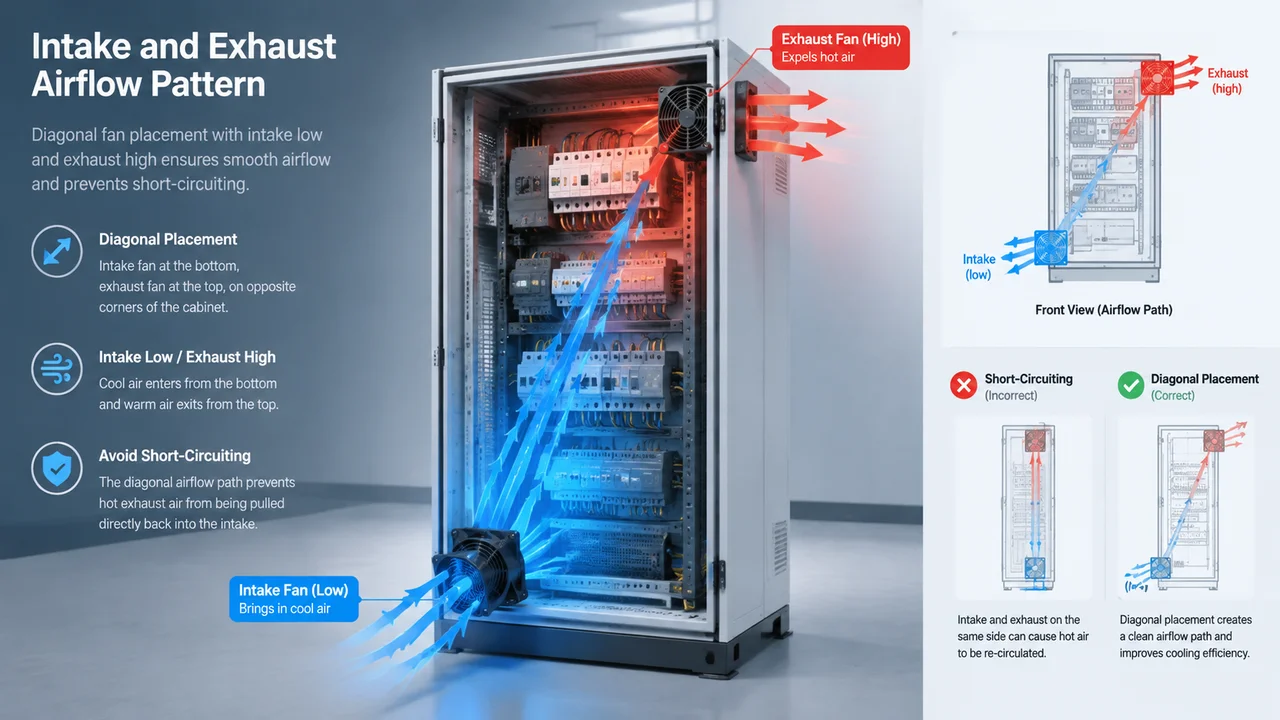
In most industrial panels the convention is exhaust fan on the top or
upper rear, with a filtered inlet louver low on the door or opposite
side. This uses natural convection (hot air rises) and keeps the
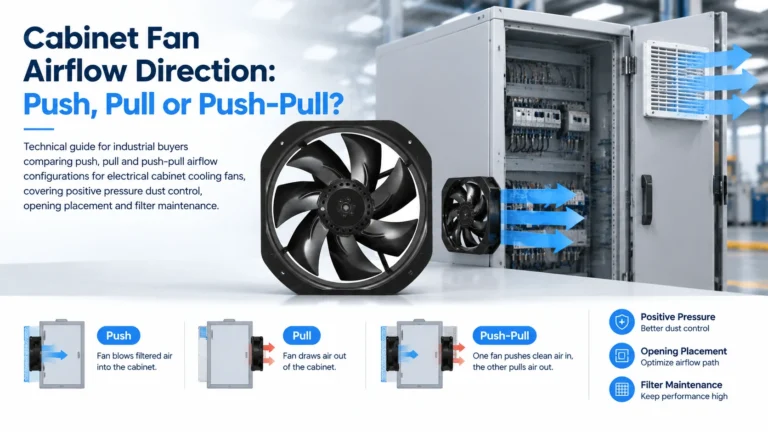
inlet away from contamination sources near the floor. Which direction the fan runs also decides whether the cabinet sits under positive or negative pressure, and which way dust leaks through the gaps; our guide to cabinet fan airflow direction works through that trade-off in detail.
Fan Placement and Airflow Direction
Good airflow pattern matters as much as raw airflow. Two practical
rules:
Route inlet air past the components that benefit from the coolest, freshest air — usually the power electronics, not the terminal block.
Avoid short-circuiting: if the inlet and outlet are on the same wall, air can flow straight from one to the other without washing over the heat sources.
A diagonal arrangement (intake low-front, exhaust high-rear) usually
gives the best component coverage in a single-door cabinet. For tall
cabinets with drives stacked top to bottom, add a ducted exhaust directly
above the drive to capture the hottest plume.
Static Pressure and the Effect of Filters and Grilles
Real cabinet installations are not at zero static pressure. A filter
mat, wire grille, louvered vents, and internal ducts all add
resistance the fan must overcome. Typical pressure drops:
Standard G3 filter mat, clean: 20–40 Pa
Same mat near service interval (dust-loaded): 60–120 Pa
Wire grille or finger guard: 5–15 Pa
Louvered vent with foam: 30–80 Pa
Long internal duct (~1 m): 10–30 Pa
Always check the fan curve at the operating static pressure, not at
zero. A fan that delivers 220 m³/h free-air may only deliver
150 m³/h through a loaded filter — that could mean the
difference between an enclosure that runs cool and one that trips on
overtemperature.
Voltage, Frequency and Power Supply
Match the fan to the available supply. Single-phase AC fans are
usually 110 V or 220/230 V, 50/60 Hz. Three-phase
380/400 V fans are used on larger frames (typically above
200 mm). DC fans are commonly 12 V, 24 V, or 48 V;
check polarity — reversed polarity on a DC fan will usually
destroy the electronics within seconds.
For sites with unstable mains, choose a fan with a wide-voltage input
range or add a small UPS for the fan circuit so the enclosure does
not overheat during a brown-out.
Noise, Speed and Service Life
Noise is rated in dB(A) at 1 m free field. For cabinet fans
installed in an operator area, target 35–45 dB(A). For
remote or outdoor cabinets, up to 55 dB(A) is acceptable.
Fan life is dominated by bearing life. Sleeve bearings are cheaper
but typically last 20,000–30,000 hours at 25 °C and
fail faster when mounted horizontally or in high-temperature cabinets.
Ball bearings last 50,000–70,000 hours and tolerate any
mounting orientation; they are the right choice for sealed cabinets
where the fan runs 24/7 and replacement means shutting the panel down.
IP Rating and Environmental Conditions
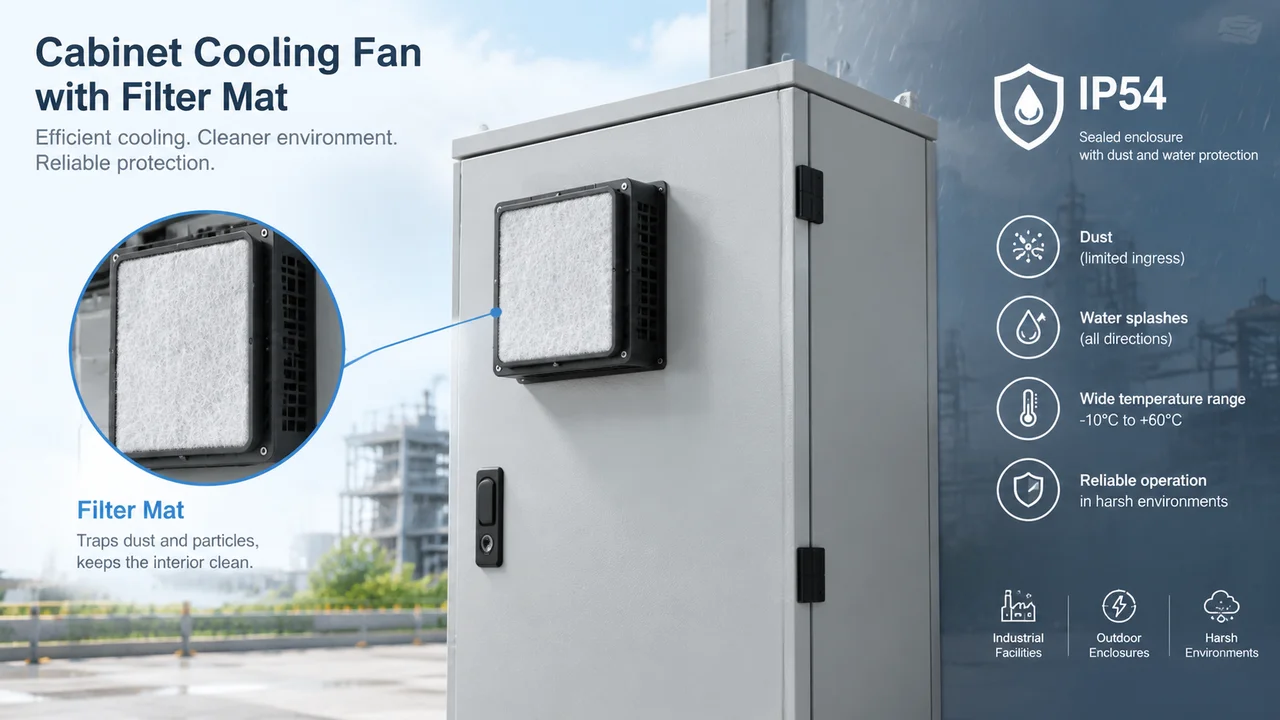
IP rating describes the enclosure, not the fan by itself. For IP54 or
IP55 cabinets use a filter fan on the inlet and an exhaust filter on
the outlet. For IP65 and above you cannot use a filter fan (the filter
is a deliberate leak path); use a closed-loop system (heat exchanger or
cabinet air conditioner) instead.
Environmental conditions drive the choice:
Dusty/dry — filter fan with regular mat replacement; consider G4-grade filter.
Oil mist — oil-resistant mat, or move to a heat exchanger.
Outdoor / rain — IP54+ cabinet with shielded intake; add a hood for direct rain exposure.
Coastal / corrosive — salt-spray-resistant fan coating, or fully sealed cooling only.
High ambient (> 50 °C) — heat-resistant bearing grease, derated fan, or cabinet air conditioner.
Common Cabinet Cooling Fan Selection Mistakes
These are the mistakes we see most often when customers ask why their
cabinet is still overheating after installing a fan:
Sizing from free-air rating. Real airflow through a filter is much lower. Always check the curve at operating static pressure.
Ignoring altitude. Above 1500 m the same fan moves ~10% less air; either upsize or accept derating.
Filter not serviced. A clogged filter mat can drop airflow to a small fraction of clean-condition performance. Build a maintenance schedule into the panel documentation.
Wrong voltage. 110 V fans on 220 V supplies burn out instantly. 24 V DC fans on reversed polarity fail equally fast.
Inlet and outlet too close. Air short-circuits from one to the other without washing over the heat sources. Use diagonal placement.
Wrong bearing type for the duty. Sleeve bearings on horizontal mounts or 24/7 duty fail early; use ball bearings.
Specifying an IP rating the cooling method cannot deliver. Filter fans cannot achieve IP65; choose heat exchangers or A/C for sealed cabinets.
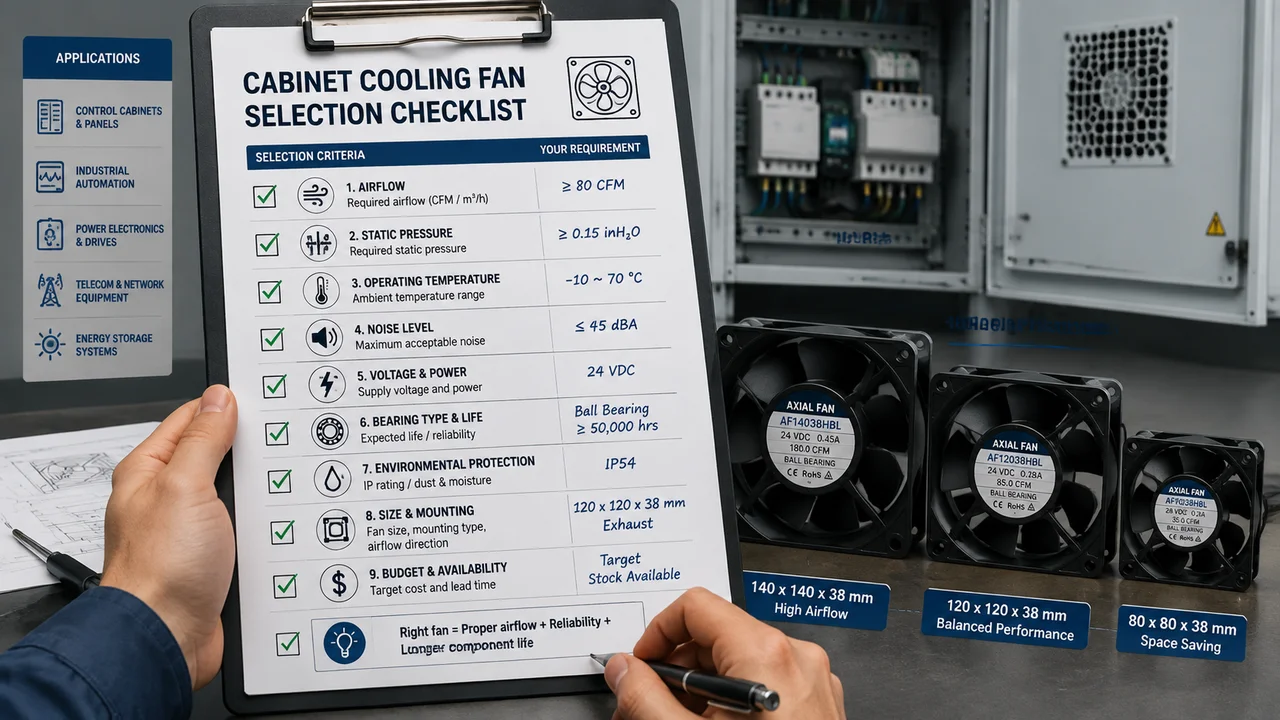
Cabinet Cooling Fan Selection Checklist
Run through this checklist before issuing a purchase order:
Total internal heat loss calculated (W)?
Maximum ambient confirmed at the installation site (°C)?
Maximum allowable internal temperature set, with 10 K margin?
Required airflow calculated with Q = 3.1P/ΔT and a 1.2–1.5 safety factor?
Static pressure at the operating point (filter + grille + duct) estimated?
Fan curve checked at operating pressure, not at free-air?
Supply voltage confirmed (AC or DC, single or three phase)?
Fan size fits the cabinet cut-out and clearance?
Mounting orientation compatible with bearing type?
IP rating compatible with the cooling method?
Noise level acceptable at the installation site?
Filter mat maintenance plan in place?
Spare fan part number recorded for future replacement?
When to Use a Filter Fan, Heat Exchanger or Air Conditioner
Filter fans, heat exchangers, and cabinet air conditioners are the
three main cooling technologies for sealed cabinets. Each fits a
different operating envelope.
Technology
Best for
Capacity
IP limit
Pros
Limitations
Filter fan
Clean industrial environments, modest heat load
20–800 W
IP54 / IP55
Lowest cost, simple install, easy to maintain
Filter needs service; cannot seal above IP55
Heat exchanger
Dirty, oily, or outdoor environments
30–250 W
IP65
Keeps cabinet sealed, no filter to clog
Limited ΔT (5–10 K); weak in hot ambient
Cabinet air conditioner
Hot or harsh ambient, sensitive electronics
300–4000 W
IP54 / IP55 (indoor)
Precise temperature control, isolates from ambient
Highest cost; needs condensate drain or refrigerant
Use filter fans when ambient is clean and ΔT is moderate (under
15 K). Move to a heat exchanger when ambient is too dirty, humid,
or corrosive to draw into the cabinet. Use a cabinet air conditioner
when ambient temperature is above the target internal temperature, or
when the heat load is high enough that filter fans become impractical.
Recommended Product Options
Yian Electric supplies a full range of cabinet cooling fans. Three
representative options from our catalogue:
Small AC Axial Fan 120 / 150 / 172 mm — AC 110/220 V, ball bearing, 60–220 m³/h free-air. See the Small AC Fan category .
Small DC Axial Fan 120 / 172 mm — DC 12/24/48 V, PWM or analogue speed control, ideal for battery-powered cabinets. Browse the Small DC Fan category .
EC External Rotor Exhaust Fan 300–710 mm — for larger enclosures, see the EC External Rotor Exhaust Fan product page.
Need help matching a fan to your exact heat load, IP rating, and
supply voltage? Send us your panel dimensions and component list; we
will recommend a model, supply voltage, and filter configuration.
Contact the Yian Electric engineering team for project consultation.
Conclusion
A reliable electrical cabinet cooling fan selection
comes down to four things: a real heat-load number, an honest
calculation of the required airflow at the actual static pressure, a
fan that delivers that airflow at the supply voltage you have, and a
cooling method (filter fan, heat exchanger, or A/C) that matches the
IP rating and environment. Use the worked example above as a template,
work through the selection checklist before ordering, and document the
filter maintenance schedule so performance does not silently degrade
after the first year. When in doubt, send your numbers to the Yian
Electric engineering team and we will specify the right fan for your
cabinet.
FAQs
How do I calculate the required airflow for a cabinet cooling fan?
Use Q = 3.1 × P / ΔT, where P is total internal heat
loss in watts and ΔT is the allowable temperature rise in
kelvin. Add a 1.2–1.5 safety factor for filter loading and
altitude.
Should the fan blow air in or pull air out?
Either works. In dusty environments put the fan on the inlet side so
the filter catches contamination before it enters. In clean
environments put the fan on the exhaust side and use a filtered
grille on the inlet.
Can I use a filter fan and still meet IP65?
No. A filter is a deliberate leak path, so a filter fan installation
is limited to IP54/IP55. For IP65 use a heat exchanger or cabinet air
conditioner.
AC or DC fan — which is better for a control cabinet?
AC fans are simpler when the cabinet has a mains supply. DC fans
(12 V/24 V/48 V) are better for battery or solar
cabinets, when you need variable speed, or when the cabinet already
runs on DC distribution.
How often should I replace the filter mat?
In a typical industrial environment inspect every six months and
replace when pressure drop exceeds the datasheet value, or at least
once a year. In dusty environments check every three months.
What happens if I oversize the fan?
Oversizing wastes energy, increases noise, and can cause
condensation by cooling the cabinet below the outside dew point.
Pick the fan that matches your calculated airflow, not the biggest
one that fits.
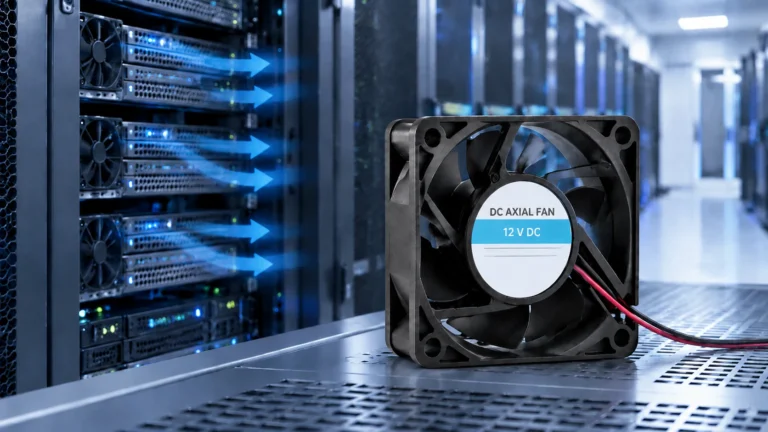
How to size and select a cooling fan for server rack duty: heat load to CFM, component fans vs cabinet ventilation, AC vs DC power, airflow direction, filters, noise and N+1 redundancy.
Choosing cabinet fan airflow direction: why positive pressure protects a control panel from dust, when to reverse the fan, and how to verify it on site.